
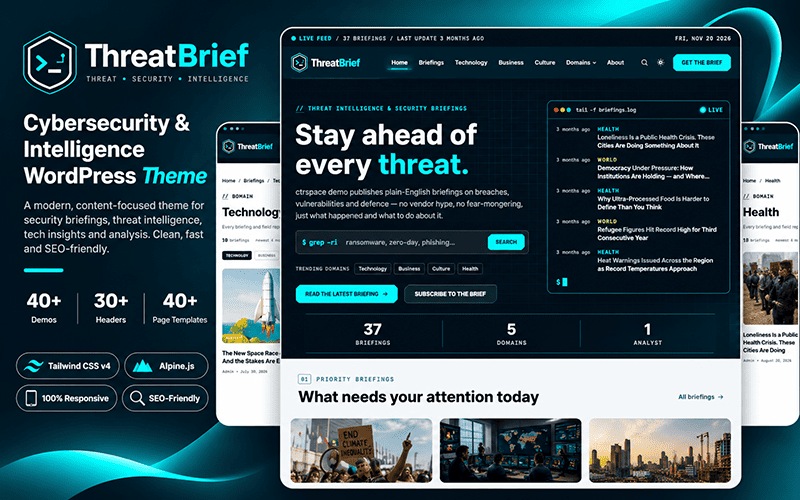
Description
CTRSpace Cybersecurity is a modern, responsive Cybersecurity WordPress Theme built specifically for security blogs, information security publications, cybersecurity educators, technical researchers and professionals who share their expertise through written content. Designed for publishers searching for a cybersecurity website template, the theme focuses on creating a professional WordPress publication rather than a cybersecurity monitoring application, penetration testing platform, or managed security service website.
Cybersecurity readers need information that is accurate, understandable, and supported by credible evidence. Whether someone is researching a newly disclosed vulnerability, learning about phishing protection or following developments in cloud security, the quality of the information matters as much as its presentation. CTRSpace Cybersecurity provides a blogging and editorial foundation for publishing security research, technical explainers, threat intelligence commentary, defensive security tutorials, cybersecurity news, and professional analysis.
Built with Tailwind CSS v4, Alpine.js, and Vanilla JavaScript, the theme combines readable typography, responsive layouts, an SEO-friendly editorial structure, and performance-conscious frontend technology. Whether you’re building an independent security research blog, publishing industry analysis or developing a collection of educational cybersecurity resources, CTRSpace Cybersecurity gives your content a consistent professional home.
CTRSpace Cybersecurity At A Glance
| Feature | Details |
| Product Type | Cybersecurity Blogging WordPress Theme |
| Best For | Cybersecurity Research, Security News, Tutorials & Technical Content |
| Main Purpose | Blogging & Editorial Publishing |
| Vulnerability Scanner | No |
| Threat Monitoring Platform | No |
| Penetration Testing Toolkit | No |
| SIEM or SOC Platform | No |
| Responsive | 100% Responsive Design |
| Styling | Tailwind CSS v4 |
| Interactions | Alpine.js + Vanilla JavaScript |
| Typography | Inter Font, Loaded Locally |
| Animations | GSAP, Used Selectively |
| Sliders | Swiper.js, Where Required |
| SEO | SEO-Friendly Structure |
| Performance | Lightweight, Core Web Vitals-Focused Architecture |
| Platform | WordPress |
What Is CTRSpace Cybersecurity?
CTRSpace Cybersecurity is a Cybersecurity Blog WordPress Theme created for individuals and editorial teams that publish educational, analytical and research-focused content about digital security.
It provides a professional publishing foundation for subjects such as:
- Cybersecurity news and updates
- Threat intelligence analysis
- Vulnerability research
- Security advisories
- Ethical hacking education
- Network security guides
- Cloud security articles
- Application security tutorials
- Data protection and privacy
- Security awareness resources
- Incident response analysis
- Malware research
- Security tool reviews
- Security frameworks and governance
- Cybersecurity career development
The theme’s purpose is to organize and present security information through WordPress articles, categories and other editorial resources. It does not detect threats, scan systems, perform vulnerability assessments or protect website visitors’ devices. Those capabilities require dedicated cybersecurity tools and services.
Built For Cybersecurity Blogs
Cybersecurity publications serve audiences with different technical backgrounds and informational needs. A beginner may want to understand multi-factor authentication. A system administrator might be researching secure configuration practices. A security analyst may need to interpret a vulnerability advisory, while a business leader could be evaluating security risks.These audiences require different levels of explanation.
A useful cybersecurity blog should make technical assumptions clear, distinguish introductory guidance from advanced analysis and help readers locate relevant supporting information. CTRSpace Cybersecurity is suitable for building a publication that organizes content according to security disciplines, technical subjects and levels of expertise.
A publisher might maintain introductory security guides alongside more advanced articles about incident response, vulnerability management and cloud security. A consistent editorial design helps these different article types remain part of a recognizable publication without forcing all readers into the same technical level.
Publish Cybersecurity News And Industry Updates
Cybersecurity is a rapidly changing field. New vulnerabilities, software updates, emerging attack techniques and policy developments can affect individuals and organizations. A cybersecurity news blog should help readers understand not only what happened but also why the development matters.
For example, an article about a newly disclosed software vulnerability could explain:
- Which product or component is affected
- Which versions are known to be vulnerable
- The type of security impact
- Whether exploitation has been confirmed
- Available vendor guidance
- Relevant patches or mitigations
- When the information was last reviewed
This level of detail is more valuable than repeating an alarming headline without context. CTRSpace Cybersecurity provides an editorial environment for publishing timely security developments alongside evergreen educational resources. Publishers should rely on primary sources, vendor advisories, and reputable technical research wherever possible.
Create Threat Intelligence And Cyber Threat Analysis
Threat intelligence content helps readers understand malicious activity, attacker behavior and potential risks. However, reporting that a particular threat exists is different from explaining its likelihood or relevance to a specific organization. A threat analysis article should establish the available evidence and identify the conditions under which the threat matters.
A cybersecurity publication can cover:
- Threat actor activity
- Phishing campaigns
- Ransomware developments
- Credential theft trends
- Malicious infrastructure research
- Attack technique analysis
- Indicators of compromise
- Defensive monitoring considerations
For example, an article about a phishing campaign could explain the social engineering technique, the type of information targeted and the defensive measures organizations can consider.
Authors should distinguish independently verified observations from information attributed to third-party reports. CTRSpace Cybersecurity provides a publishing foundation for this analysis, not an automated threat intelligence feed or detection system.
Publish Vulnerability Research And Security Advisories
Vulnerability research is a specialized area of cybersecurity publishing. Readers may need specific information about affected products, technical severity, exploitability, and available remediation guidance. A vulnerability-focused publication can produce educational articles explaining security weaknesses, vendor advisories, and defensive priorities.
Useful vulnerability content may include:
- Vulnerability identifiers such as CVEs
- Affected products and versions
- Relevant vulnerability classifications
- Technical impact
- Exploitation prerequisites
- Available fixes
- Temporary mitigations
- Source references
- Disclosure and update timelines
Not every published vulnerability has been exploited, and a high severity score does not automatically mean every organization faces the same operational risk. Where relevant, authors should distinguish technical severity from exposure, exploitability and business impact. CTRSpace Cybersecurity is appropriate for publishing vulnerability analysis while keeping verification and technical accuracy under the publisher’s responsibility.
Create Ethical Hacking Educational Content
Ethical hacking education helps learners understand security testing concepts and defensive weaknesses in systems they are authorized to assess. An educational publication can explain security testing methodologies, common classes of vulnerabilities, responsible disclosure, and safe laboratory practices.
Relevant editorial topics include:
- Ethical hacking fundamentals
- Authorization and scope
- Security testing methodologies
- Web application security concepts
- Network assessment principles
- Vulnerability classification
- Security lab environments
- Responsible disclosure
- Technical learning resources
For example, an article about authorization can explain why permission, defined scope, and rules of engagement are essential before conducting a security assessment. Educational demonstrations should use authorized lab environments and avoid exposing real-world systems or confidential information. CTRSpace Cybersecurity provides a blogging platform for teaching these concepts. It is not a penetration testing tool or an environment for executing security assessments.
Publish Network Security Guides
Network security is a core area of cybersecurity education. Organizations rely on connected infrastructure, services and devices that require appropriate security configuration and monitoring.
A network security blog can publish articles covering:
- Network segmentation
- Firewalls and access controls
- Secure network architecture
- Wireless network protection
- Virtual private networks
- Intrusion detection concepts
- Network traffic analysis
- Secure remote access
- Network monitoring principles
A guide about network segmentation, for example, could explain how separating systems according to business requirements may reduce unnecessary access between environments. Effective technical articles should identify the relevant network context and clarify where recommendations require additional expertise. CTRSpace Cybersecurity supports the presentation of these explanations through educational posts and professional technical commentary.
Create Cloud Security Content
Cloud security introduces operational considerations that differ from traditional on-premises infrastructure. Cloud environments often involve shared responsibility, identity management, configuration, data protection and service-specific controls.
CTRSpace Cybersecurity is suitable for publishing articles about:
- Cloud security fundamentals
- Shared responsibility models
- Identity and access management
- Cloud configuration risks
- Cloud workload protection
- Storage access controls
- Cloud monitoring
- Container security
- Cloud security governance
For example, an article about cloud storage security could explain why access policies, encryption settings, and public exposure controls must be evaluated within the context of the specific cloud provider. Publishers should identify provider-specific differences rather than presenting one configuration method as universally applicable. The theme provides an editorial foundation for cloud security education, not a cloud security management platform.
Publish Application And Web Security Tutorials
Application security helps developers and technical teams understand how security considerations affect software design, development and deployment. A cybersecurity publication can cover secure development practices, common application weaknesses and defensive coding concepts.
Suitable topics include:
- Web application security
- Authentication and authorization
- Session security
- API security fundamentals
- Input validation
- Dependency management
- Secure development workflows
- Application security testing
- Common vulnerability classes
- Security review practices
For example, an article about authentication can explain the difference between verifying a user’s identity and determining what that user is permitted to access. Developers benefit from precise terminology and explanations that connect security concepts to real implementation decisions. CTRSpace Cybersecurity offers a content-focused publishing environment for these technical articles.
Create Digital Privacy And Data Protection Guides
Cybersecurity and privacy overlap, but they are not identical disciplines. Cybersecurity commonly concerns protecting systems and information from threats, while privacy includes appropriate collection, use, disclosure, and governance of personal information.
A cybersecurity blog can publish educational resources covering:
- Personal data protection
- Secure account practices
- Password managers
- Multi-factor authentication
- Device privacy settings
- Data minimization
- Privacy risk awareness
- Secure communication
- Information handling
- Privacy regulations and developments
A guide about multi-factor authentication could explain different authentication factors, phishing-resistant methods and common misconceptions. Legal discussions should identify the applicable jurisdiction and avoid implying that general blog content replaces qualified legal advice. CTRSpace Cybersecurity supports educational privacy publishing within a broader information security publication.
Publish Security Awareness And Phishing Prevention Content
Security awareness articles help explain risks faced by ordinary users and employees. These resources should offer actionable defensive information without relying on exaggerated fear.
A security awareness blog may cover:
- Phishing recognition
- Suspicious email reporting
- Account takeover prevention
- Password security
- Safe browsing habits
- Device update practices
- Social engineering awareness
- Secure file sharing
- Mobile security basics
- Workplace security habits
A useful phishing article might explain common warning signs while noting that sophisticated phishing messages may look convincing. It could also explain the safer practice of navigating independently to a trusted website instead of following an unexpected message link. Such content can serve individuals, small businesses and workplace education programs.
Publish Incident Response And Security Operations Insights
Incident response concerns how organizations prepare for, identify, manage and recover from security incidents. A technical publication can explore incident response concepts without claiming to provide an operational incident management system.
Relevant educational subjects include:
- Incident response planning
- Detection and triage
- Incident severity assessment
- Evidence preservation
- Containment considerations
- Recovery planning
- Post-incident review
- Security operations workflows
- Security monitoring concepts
For example, an article about incident documentation might explain the importance of maintaining accurate timelines, recording observed evidence and distinguishing confirmed facts from assumptions. Incident response decisions are highly context-dependent. Publishers should not present generic instructions as a substitute for a qualified response team during an active security emergency.
CTRSpace Cybersecurity is suitable for publishing educational analysis, lessons learned and professional commentary on these processes.
Create Malware Research And Analysis Articles
Malware-related publishing often requires technical precision. A useful malware analysis article should identify the sample or family being discussed, describe documented behavior and distinguish observed findings from general assumptions.
A cybersecurity blog may cover:
- Malware classifications
- Ransomware analysis
- Malicious document risks
- Persistence techniques
- Malware detection concepts
- Security research methodology
- Defensive indicators
- Relevant security advisories
Researchers should protect sensitive information and avoid publishing harmful material or instructions that unnecessarily increase risk. Where findings are based on external reports, sources should be clearly identified. CTRSpace Cybersecurity provides an editorial foundation for responsible malware research reporting and education.
Publish Cybersecurity Framework And Governance Content
Security frameworks help organizations understand and organize cybersecurity activities. A professional cybersecurity publication can explain recognized approaches to governance, risk management, and security controls. One important reference is the NIST Cybersecurity Framework 2.0, which organizes cybersecurity outcomes around six functions: Govern, Identify, Protect, Detect, Respond, and Recover. Publishers can create explanatory articles about these concepts and how they relate to organizational security planning.
Relevant content includes:
- Cybersecurity risk management
- Security governance
- Security policies
- Asset identification
- Protective controls
- Detection and monitoring
- Incident response planning
- Recovery preparedness
- Security program maturity
The purpose of these articles is to help readers understand frameworks and evaluate their relevance. CTRSpace Cybersecurity is a content publishing theme and does not automatically assess compliance or implement security controls.
Publish Cybersecurity Tool Reviews And Comparisons
Security professionals often evaluate specialized products before selecting software or services. A cybersecurity blog can provide editorial assessments of tools used for protection, analysis, monitoring, and security operations.
Potential review topics include:
- Password managers
- Antivirus software
- Endpoint protection
- Network monitoring products
- Vulnerability management tools
- Cloud security platforms
- Identity management solutions
- Security awareness tools
A useful comparison should explain the evaluation criteria. For example, a password manager comparison could examine platform compatibility, authentication options, sharing capabilities, usability and account recovery considerations. Publishers should distinguish firsthand product testing from vendor statements and secondary research.
The theme supports editorial reviews and comparisons; it does not itself perform the functionality of the security products being reviewed.
Build A Cybersecurity Learning And Career Blog
Cybersecurity education also serves students, career changers and professionals seeking to expand their knowledge. A career-focused security publication can explain the differences between roles, technical disciplines and professional development pathways.
Relevant content includes:
- Cybersecurity career fundamentals
- Security analyst responsibilities
- Network security careers
- Cloud security specializations
- Ethical hacking education
- Learning roadmaps
- Security certification comparisons
- Professional skills development
- Cybersecurity interview preparation
An effective career article should explain expected skills and practical learning requirements without promising employment, certification success or particular salary outcomes. CTRSpace Cybersecurity provides a publishing foundation for these educational resources.
Publish Security Research And Technical Project Write-Ups
Cybersecurity professionals sometimes want to demonstrate their knowledge by documenting technical research, authorized lab experiments or security-related projects. These articles may form part of a professional body of work.
Examples include:
- Research methodology explanations
- Authorized lab exercises
- Defensive detection projects
- Secure configuration reviews
- Technical lessons learned
- Open-source tool analysis
- Security architecture discussions
This is where the keyword “cybersecurity portfolio website template” has limited contextual relevance. A professional can use a cybersecurity blog to publish research articles and technical project explanations that demonstrate expertise. However, CTRSpace Cybersecurity is not being sold as a dedicated portfolio-building system with custom project databases or portfolio-specific features.
Build Cybersecurity Topic Clusters
A cybersecurity publication needs clear topic organization because the field contains many specialized disciplines.
A recommended editorial structure could include:
Cybersecurity News
Current security developments, vendor announcements and industry updates.
Threat Intelligence
Threat activity, campaign analysis, malicious techniques and defensive context.
Vulnerability Research
Security advisories, vulnerability explanations and responsible technical analysis.
Ethical Hacking
Authorized security testing education, methodologies and laboratory learning.
Network And Cloud Security
Infrastructure protection, configuration concepts and cloud security practices.
Application Security
Secure development, web vulnerabilities, APIs and software security principles.
Security Operations
Detection, incident response, monitoring and recovery education.
Privacy And Awareness
Personal data protection, security habits, phishing awareness and user education.
Security Governance
Risk management frameworks, policies and organizational security planning.
Security Tools And Careers
Product comparisons, learning resources and professional development.
Publishers should choose categories according to their actual audience and depth of expertise rather than creating every category immediately.
Meaningful content relationships might include:
Vulnerability Research → Affected Software → Mitigation Guidance → Security Updates
Or:
Security Awareness → Phishing → Account Protection → Multi-Factor Authentication
And:
Security Governance → Risk Assessment → Protective Controls → Incident Response
These relationships provide readers with logical paths into more detailed information.
Professional Editorial Design
Cybersecurity articles often contain specialized terminology, technical explanations and references that require careful reading. CTRSpace Cybersecurity emphasizes a professional editorial presentation suited to technical publishing.
The design direction focuses on:
- Readable typography
- Clear heading hierarchy
- Professional article layouts
- Organized categories
- Logical navigation
- Consistent spacing
- Responsive presentation
- Comfortable long-form reading
The goal is to make technical information approachable without oversimplifying it. A well-structured article should allow readers to distinguish key findings from supporting explanations, limitations and source references.
Designed For Technical And Research-Based Content
Cybersecurity publishing may require a broader range of content formats than an ordinary personal blog. Security articles can include vulnerability tables, technical examples, screenshots, diagrams, research references, and structured explanations.
Appropriate editorial formats include:
- Technical tutorials
- Step-by-step defensive guides
- Code excerpts
- Log examples
- Security diagrams
- Threat analysis tables
- Vulnerability summaries
- Incident timelines
- Tool comparisons
- Research references
- Key findings and limitations
The exact display and styling of code blocks, diagrams, and other specialized elements depend on the WordPress editor and implemented theme styles. Publishers should remove secrets, private credentials, sensitive system data, and unauthorized information before sharing technical examples.
100% Responsive Design
CTRSpace Cybersecurity follows a 100% responsive design approach.
Its layouts and typography are intended to adapt across:
- Desktop computers
- Laptops
- Tablets
- Smartphones
- Modern screen sizes
Responsive presentation matters for readers reviewing security news or educational material from different devices. Technical content such as wide tables and code examples may require additional responsive formatting to remain usable on smaller screens. Publishers should test these elements in the final website configuration.
Performance-Focused Architecture
CTRSpace Cybersecurity uses a focused frontend technology stack built around:
- Tailwind CSS v4
- Alpine.js
- Vanilla JavaScript
- Locally hosted Inter font
- Selective GSAP animations
- Swiper.js where required
The architecture is intended to support efficient presentation and modern interactions without unnecessary frontend complexity. For a research-focused blog, page loading and content stability matter because readers may be navigating long articles containing diagrams, screenshots and technical references. Actual performance depends on hosting, media optimization, plugin configuration, caching and third-party resources.
Core Web Vitals-Focused Foundation
CTRSpace Cybersecurity is developed with performance principles relevant to Core Web Vitals.
These include:
- Stable page layouts
- Efficient resource loading
- Controlled frontend interactions
- Responsive visual components
- Purposeful animation use
- Optimized content presentation
Largest Contentful Paint, Interaction to Next Paint and Cumulative Layout Shift are important measures of real-world page experience. The theme’s frontend stack provides a performance-conscious foundation, but specific metrics cannot be guaranteed without testing the complete website.
Built With Tailwind CSS V4
Tailwind CSS v4 is the theme’s primary frontend styling system. It supports consistent design patterns for typography, spacing, responsive layouts, navigation and editorial components. A cybersecurity publication may contain introductory guides, technical research, and breaking security coverage. Consistent styling helps these different article types remain visually connected and supports a recognizable publishing identity.
Lightweight Interactions With Alpine.Js
Alpine.js provides a lightweight approach to frontend interactivity. It is suitable for navigation dropdowns, toggles, tabs, and expandable interface elements where those features are implemented. This enables purposeful interface behavior without requiring a large application framework. The technology does not provide security scanning, vulnerability monitoring or threat detection functionality.
Vanilla JavaScript
Vanilla JavaScript is used for additional frontend behaviors that do not require Alpine.js. This keeps custom interactions focused and avoids introducing dependencies where standard JavaScript is sufficient. The objective is a responsive publishing interface, not a browser-based cybersecurity application.
Locally Hosted Inter Font
CTRSpace Cybersecurity uses the Inter font, loaded locally. Its clean typography is appropriate for technical publishing involving detailed explanations, terminology and research references. Local hosting reduces reliance on external font services and supports consistent typography across the publication.
Selective GSAP Animations
GSAP is used selectively where animation improves presentation. For security-related editorial content, motion should not interfere with readability, accessibility or technical accuracy. Animations remain secondary to the information being communicated.
Swiper.Js Where Required
Swiper.js is used where the implemented design requires sliders or carousels. Featured security articles or editorial highlights may benefit from this presentation when it improves content discovery. Such components should remain purposeful and accessible.
SEO-Friendly Cybersecurity WordPress Theme
CTRSpace Cybersecurity provides an SEO-friendly publishing foundation for cybersecurity articles, tutorials, research and industry commentary. Security-related searches often have precise informational intent. Someone searching for the meaning of a security term requires an explanation. Someone researching a specific vulnerability needs accurate technical information about affected products, consequences, and remediation.
A cybersecurity SEO strategy should distinguish these intents.
Important editorial considerations include:
- Descriptive article titles
- Accurate technical terminology
- Clear heading structures
- Original research or expert analysis
- Relevant internal links
- Author information
- Source citations
- Publication and update dates
- Appropriate structured data
- Responsive article presentation
WordPress and compatible SEO plugins can support metadata and structured data where properly configured. CTRSpace Cybersecurity does not guarantee rankings, traffic or inclusion in search features.
Built For Direct Cybersecurity Answers
Readers frequently search for concise answers to technical questions.
A cybersecurity publication can build helpful resources around questions such as:
- What is cybersecurity?
- What is a CVE?
- What is phishing?
- How does multi-factor authentication work?
- What is a zero-day vulnerability?
- What is threat intelligence?
- What is the difference between authentication and authorization?
- What is incident response?
- What is network segmentation?
- What is the NIST Cybersecurity Framework?
A useful article can begin with a clear definition, followed by technical context, practical examples and relevant limitations. For example, an article explaining CVEs should distinguish the vulnerability identifier from severity scoring and explain where readers can find official vulnerability information. This approach is more valuable than repeatedly using related keywords without addressing the underlying question.
Built For Semantic Cybersecurity Content
Cybersecurity concepts are interconnected.
A structured publication can guide readers through related subjects in a logical sequence.
For example:
Cybersecurity → Risk Management → Security Controls → Monitoring → Incident Response
Or:
Application Security → Vulnerabilities → Security Testing → Remediation → Verification
And:
Identity Security → Authentication → Multi-Factor Authentication → Access Control
These relationships can support content planning and relevant internal linking. The goal is to build a coherent body of information that helps readers understand how cybersecurity concepts relate to one another.
Support Security Researcher And Author Credibility
Cybersecurity content can influence technical and organizational decisions. Readers should be able to understand the expertise behind research, tutorials and recommendations.
Publishers may provide author information covering:
- Security specialization
- Professional experience
- Technical qualifications
- Research interests
- Relevant certifications
- Published work
- Disclosure responsibilities
WordPress provides an author-based publishing model, while the appearance of author profiles depends on the implemented theme templates. Credentials and technical achievements should be accurate and verifiable. Authors should avoid implying that opinions or unverified findings represent confirmed security research.
Cybersecurity Content Requires Technical Accuracy
Inaccurate cybersecurity guidance can create serious risks.
A recommendation that is appropriate for one environment may be ineffective or unsafe in another.
Publishers should:
- Verify technical claims
- Identify affected products and versions
- Cite authoritative advisories
- Explain relevant assumptions
- Distinguish confirmed findings from speculation
- Review updates and mitigations
- Avoid unsupported security guarantees
- Clarify when professional assistance is required
- Protect sensitive research information
When publishing vulnerability information, official vendor guidance and relevant vulnerability databases should be consulted. Readers should not be encouraged to perform unauthorized security testing. These practices help a cybersecurity publication maintain technical credibility and prioritize responsible education.
Keep Security Information Current
Cybersecurity information changes as software is updated, vulnerabilities are investigated, and new evidence emerges. A publication should distinguish between evergreen educational concepts and time-sensitive technical guidance. For example, an introductory article about encryption fundamentals may remain useful for a long period, while a mitigation guide for an actively exploited vulnerability may require urgent updates.
Relevant content maintenance includes:
- Reviewing vendor advisories
- Checking affected version information
- Updating mitigation guidance
- Correcting outdated screenshots
- Revising obsolete technical references
- Identifying superseded recommendations
- Recording meaningful changes
Publishers should not change article dates merely to create an appearance of freshness. Updates should reflect actual editorial review or new information.
Responsible Security Research And Disclosure
Cybersecurity publishing can involve information about real vulnerabilities, technical weaknesses, and security incidents. Researchers should follow applicable laws, authorization requirements, and responsible disclosure practices. Technical articles should avoid exposing credentials, personal information, confidential system details, or unnecessary operational instructions that could create preventable harm.
When discussing third-party incidents, publishers should distinguish verified public information from speculation. CTRSpace Cybersecurity provides the blogging environment for responsible security reporting; it does not verify research, approve disclosures or assume responsibility for the publisher’s technical activity.
What Makes CTRSpace Cybersecurity Different?
Built Specifically For Cybersecurity Blogging
The theme focuses on security education, technical articles and editorial publishing rather than operating monitoring or scanning services.
Security Research Publishing
Suitable for technical write-ups, vulnerability analysis and documented research findings.
Cybersecurity News Coverage
Provides an editorial foundation for reporting security developments and explaining their practical implications.
Ethical Hacking Education
Appropriate for responsible tutorials, authorized lab explanations and security testing concepts.
Threat Intelligence Content
Suitable for publishing evidence-based analysis of threats, campaigns and defensive considerations.
Security Framework Coverage
Supports educational articles explaining risk management, security governance and recognized cybersecurity frameworks.
Professional Technical Design
Clean typography and structured content presentation suited to information security audiences.
Long-Form Friendly
Designed for detailed guides, security research, technical analysis and comprehensive educational resources.
100% Responsive
Intended for consistent reading across desktops, tablets and smartphones.
Modern Frontend Technology
Built with Tailwind CSS v4, Alpine.js, Vanilla JavaScript and locally hosted Inter typography.
SEO-Friendly Foundation
Provides a publishing-focused structure for useful, well-organized cybersecurity content.
Key Features
- Cybersecurity Blogging WordPress Theme
- Cybersecurity News Publishing
- Information Security Articles
- Threat Intelligence Content
- Vulnerability Research
- Security Advisory Analysis
- Ethical Hacking Educational Content
- Network Security Guides
- Cloud Security Articles
- Application Security Tutorials
- Digital Privacy Content
- Phishing Awareness Guides
- Incident Response Education
- Malware Research Articles
- Security Governance Content
- Cybersecurity Tool Reviews
- Technical Comparisons
- Research and Project Write-Ups
- Cybersecurity Career Guides
- Long-Form Editorial Publishing
- Category-Based Content Organization
- WordPress Author-Based Publishing
- 100% Responsive Design
- SEO-Friendly Structure
- Core Web Vitals-Focused Architecture
- Tailwind CSS v4
- Alpine.js
- Vanilla JavaScript
- Locally Hosted Inter Font
- Selective GSAP Support
- Swiper.js Where Required
Who Should Use CTRSpace Cybersecurity?
CTRSpace Cybersecurity is suitable for:
- Cybersecurity bloggers
- Information security writers
- Security researchers
- Ethical hacking educators
- Cybersecurity journalists
- IT security professionals
- Network security specialists
- Cloud security writers
- Application security educators
- Threat intelligence analysts
- Security operations professionals
- Digital privacy bloggers
- Cybersecurity career educators
- Security technology reviewers
- Independent technical researchers
- Multi-author security publications
The theme is especially suitable for individuals and teams whose primary goal is publishing useful cybersecurity information.
Frequently Asked Questions
Is CTRSpace Cybersecurity a blogging WordPress theme?
Yes. CTRSpace Cybersecurity is designed specifically for cybersecurity blogging and editorial publishing, including tutorials, research, industry news and security education.
Can I use it as a cybersecurity website template?
Yes. It is suitable for creating a cybersecurity-focused WordPress blog or editorial publication. It is not a complete cybersecurity service management or monitoring platform.
Is the theme suitable for cybersecurity researchers?
Yes. Researchers can publish technical explanations, research articles and project write-ups using WordPress content tools.
Can I create an ethical hacking blog?
Yes. CTRSpace Cybersecurity is appropriate for responsible ethical hacking education, authorized laboratory guides and security testing concepts.
Can I publish cybersecurity news?
Yes. The theme is suitable for security announcements, industry developments, vulnerability coverage and related professional commentary.
Can I publish vulnerability research and CVE articles?
Yes. Publishers can create articles discussing vulnerabilities, affected software, security impact and available mitigations. Claims should be supported by credible sources.
Can I publish network and cloud security tutorials?
Yes. Network security, cloud security and infrastructure protection are relevant subjects for the theme.
Does the theme include vulnerability scanning software?
No. CTRSpace Cybersecurity is a blogging theme and does not include a native vulnerability scanner.
Does it include threat monitoring or SOC functionality?
No. It does not provide a security operations center, SIEM, live monitoring or automated threat detection.
Can I publish cybersecurity tool reviews?
Yes. Security software reviews, comparisons and educational buying guides are suitable editorial content.
Is it suitable for a cybersecurity professional portfolio?
It can be used to publish research articles and technical project write-ups that demonstrate professional expertise. Dedicated portfolio management features are not claimed.
Can I publish security frameworks and compliance education?
Yes. Articles about NIST CSF, security governance, risk management and relevant compliance concepts are suitable subjects. The theme itself does not provide compliance assessment functionality.
Is CTRSpace Cybersecurity responsive?
Yes. It follows a 100% responsive design approach for desktop, tablet and mobile layouts.
Is the theme SEO friendly?
Yes. CTRSpace Cybersecurity is developed with an SEO-friendly editorial approach and performance-conscious frontend principles. Actual search performance depends on implementation, content quality, competition and broader SEO practices.
What technologies are used?
CTRSpace Cybersecurity uses Tailwind CSS v4, Alpine.js, Vanilla JavaScript and a locally hosted Inter font. GSAP and Swiper.js are used selectively where required by the design.
Is the theme suitable for long-form technical content?
Yes. Its editorial approach is intended for detailed cybersecurity tutorials, research articles, technical guides and professional analysis.




There are no reviews yet.