
Description
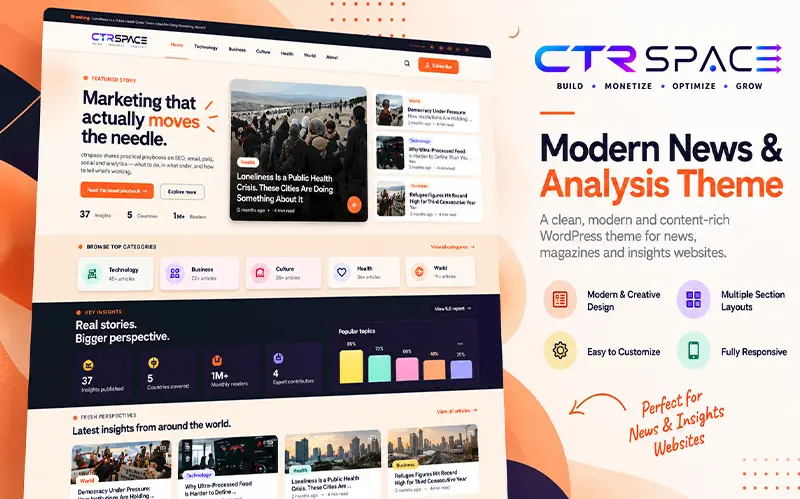
CTRSpace Digital Marketing is a modern, responsive Digital Marketing WordPress Theme designed specifically for digital marketing blogs, SEO-focused publications, content marketing professionals, marketing educators, and agencies that share industry knowledge through articles. Digital marketing is a broad and constantly evolving discipline. Readers may be researching changes in search visibility, learning how to evaluate advertising campaigns, comparing marketing tools, or exploring ways to improve their content strategies.
They need clear explanations, reliable information, and practical examples—not merely promotional claims. CTRSpace Digital Marketing provides an organized blogging foundation for publishing SEO insights, content marketing guides, paid advertising tutorials, social media strategies, email marketing resources, campaign analysis, and professional commentary. Built with Tailwind CSS v4, Alpine.js, and Vanilla JavaScript, the theme combines professional editorial presentation with responsive layouts, readable typography, and a performance-conscious frontend architecture.
Unlike traditional agency-oriented WordPress themes, CTRSpace Digital Marketing focuses on blogging and educational publishing. It is not a marketing automation system, customer relationship management application, campaign reporting dashboard, or complete agency operations platform. Whether you’re starting an independent marketing blog, building an educational resource for marketers, or developing your agency’s editorial presence, CTRSpace Digital Marketing gives your knowledge a consistent and professional publishing environment.
CTRSpace Digital Marketing at a Glance
| Feature | Details |
| Product Type | Digital Marketing Blogging WordPress Theme |
| Best For | SEO, Content Marketing, PPC, Social Media & Marketing Education |
| Main Purpose | Blogging & Editorial Publishing |
| Marketing Automation | Not Included as a Native Function |
| Advertising Campaign Management | No |
| Built-In SEO Audit Tool | No |
| CRM or Lead Management Platform | No |
| Responsive | 100% Responsive Design |
| Styling | Tailwind CSS v4 |
| Interactions | Alpine.js + Vanilla JavaScript |
| Typography | Inter Font, Loaded Locally |
| Animations | GSAP, Used Selectively |
| Sliders | Swiper.js, Where Required |
| SEO | SEO-Friendly Editorial Structure |
| Performance | Lightweight, Core Web Vitals-Focused Architecture |
| Platform | WordPress |
What Is CTRSpace Digital Marketing?
CTRSpace Digital Marketing is a Digital Marketing Blog WordPress Theme created for individuals and publishing teams who regularly produce educational, analytical and editorial content about online marketing.
It is suitable for articles covering:
- Search engine optimization
- Content marketing strategies
- Keyword research and search intent
- Paid advertising and PPC
- Social media marketing
- Email marketing
- Marketing analytics
- Conversion rate optimization
- Affiliate marketing
- Marketing technology reviews
- Digital marketing case studies
- Local SEO and business visibility
- AI applications in marketing
- Marketing news and industry developments
- Professional insights and tutorials
The theme focuses on organizing, presenting, and publishing this knowledge through WordPress. It does not directly run advertisements, collect campaign analytics, conduct automated keyword research, or manage client marketing accounts. Those activities require dedicated marketing platforms, integrations, or external services.
Built for Digital Marketing Blogs
A digital marketing publication needs to make several kinds of information accessible without confusing its audience. Some readers are beginners looking for definitions and introductory tutorials. Others are experienced marketers seeking technical explanations, campaign evaluation methods or perspectives on recent industry developments. A useful marketing blog should allow these audiences to locate content appropriate to their experience and goals.
CTRSpace Digital Marketing provides an editorial setting for organizing practical guides, research, professional commentary, and detailed analysis into recognizable subject areas. For example, an introductory article explaining search intent can connect to more advanced resources about keyword mapping, content briefs, and page optimization. Similarly, a guide to advertising metrics can provide context for detailed articles about campaign measurement or budget allocation.
This interconnected publishing approach helps build a cohesive marketing knowledge resource rather than a disconnected collection of promotional articles.
Publish SEO Guides and Search Marketing Insights
Search engine optimization is one of the most important editorial subjects for a digital marketing blog. However, SEO content should do more than repeat familiar ranking advice. Useful articles explain how search systems interpret websites, what publishers can control, and where uncertainty remains.
CTRSpace Digital Marketing is suitable for publishing educational material about:
- Keyword research and search intent
- On-page SEO
- Technical SEO principles
- Website architecture
- Internal linking
- Content optimization
- Search performance measurement
- Indexing and crawling
- Structured data
- Local search visibility
For example, a keyword research guide could explain how to distinguish informational, commercial, and transactional searches before choosing topics. An internal linking article might demonstrate how related pages can help readers find increasingly detailed information. SEO claims should reflect current search engine documentation and avoid promising rankings from individual tactics. The theme provides the editorial environment for explaining SEO concepts; it does not perform automated SEO audits or replace specialized SEO software.
Create Content Marketing Strategies and Tutorials
Content marketing is not simply the production of blog posts. It involves understanding audience needs, selecting relevant subjects, distributing useful resources and evaluating outcomes. A content marketing blog can help readers develop these capabilities through educational articles.
Suitable topics include:
- Content strategy development
- Audience research
- Editorial calendars
- Content briefs
- Topic clustering
- Content distribution
- Repurposing strategies
- Content performance measurement
- Editorial quality assurance
For example, an article about building a content calendar can explain how to map audience questions to business objectives, evaluate publishing capacity, and establish a realistic review process. The publication can also distinguish between content created to answer immediate questions and resources intended to support longer buying decisions.
CTRSpace Digital Marketing is suited to detailed content strategy guides that combine conceptual understanding with practical workflows.
Publish PPC and Paid Advertising Insights
Paid advertising content attracts readers who need help understanding campaign decisions, costs, and performance. A practical PPC article should explain the relationship between campaign objectives, targeting, creative materials, landing pages, and measurement.
CTRSpace Digital Marketing is suitable for content involving:
- Google Ads fundamentals
- Meta advertising concepts
- Campaign structures
- Paid search strategy
- Audience targeting
- Advertising budgets
- Bid strategy concepts
- Ad creative testing
- Conversion measurement
- Campaign evaluation
For example, a guide comparing Google Ads and Meta Ads could explain differences between search-driven intent and audience-based discovery. A campaign analysis might discuss cost per acquisition, conversion rates, and return on advertising spend while making its assumptions clear. Such articles should distinguish illustrative calculations from documented campaign results. CTRSpace Digital Marketing supports publishing the analysis. It does not manage live advertising accounts or provide advertising platform integrations by default.
Create Social Media Marketing Content
Social media marketing combines audience research, content planning, community participation, and performance evaluation. Because individual platforms operate differently, useful articles need platform-specific context. A social media publication can cover content planning, organic reach, campaign objectives, engagement analysis, video formats, and platform changes. For example, a guide about LinkedIn publishing might explore professional audience expectations and the types of educational content that encourage meaningful discussion.
An Instagram-focused article might examine visual storytelling, content formats, and the importance of matching creative decisions to the intended audience. CTRSpace Digital Marketing provides a blogging foundation for presenting these guides alongside broader marketing strategy articles. Publishers should distinguish documented platform changes from speculation about recommendation algorithms.
Publish Email Marketing and Newsletter Guides
Email marketing articles can help readers understand audience relationships, permission-based communication, and campaign evaluation.
An educational publication can explain:
- Email audience segmentation
- Newsletter planning
- Campaign objectives
- Welcome sequences
- Subject line testing
- Email content strategy
- Deliverability fundamentals
- Consent and unsubscribe practices
- Email performance metrics
For example, an article about welcome emails could explain why expectations, timing and message relevance matter when introducing a new subscriber to a publication. Technical and compliance advice should reflect the recipient’s jurisdiction and the applicable email service requirements. CTRSpace Digital Marketing is suitable for publishing this information, but it does not itself function as an email service provider or marketing automation tool.
Cover Marketing Analytics and Performance Measurement
Marketing data becomes useful when it helps someone make a clearer decision. Metrics without business context can create misleading conclusions. CTRSpace Digital Marketing is appropriate for articles explaining traffic measurement, campaign attribution, conversion tracking, and marketing performance.
A marketing analytics publication could cover:
- Google Analytics 4 concepts
- Google Search Console reporting
- Website engagement
- Traffic sources
- Campaign attribution
- Conversion definitions
- UTM parameters
- Reporting limitations
- Performance dashboards
- Marketing experimentation
For example, a guide to conversion rate can explain how the chosen conversion event and denominator affect interpretation. An article about campaign attribution may compare different attribution approaches while acknowledging that observed conversions cannot always be assigned to one marketing touchpoint with certainty.
These topics benefit from careful definitions, realistic examples, and clear explanations of data limitations. The theme supports analytical writing; it does not provide a native analytics dashboard or automated reporting system.
Create Conversion Rate Optimization Guides
Conversion rate optimization connects visitor behavior with website and campaign objectives. A useful CRO publication helps readers formulate hypotheses, evaluate evidence, and design meaningful improvements. Relevant topics include landing page clarity, calls to action, form usability, user experience research, experimentation, and conversion measurement.
For example, an article about improving a landing page could explain how unclear messaging, excessive distractions, or mismatched expectations affect visitor decisions. Rather than claiming that a particular button color will always improve conversions, the article can explain how controlled testing may provide evidence about a specific audience.
CTRSpace Digital Marketing offers an editorial foundation for publishing CRO education, case studies, and practical recommendations.
Publish Affiliate Marketing Education
Affiliate marketing connects publishers with merchants through referral-based commercial arrangements. A marketing blog can help readers understand how affiliate programs operate, how to evaluate suitable partnerships, and how to maintain trustworthy content.
Relevant editorial subjects include:
- Affiliate program selection
- Affiliate content strategy
- Product reviews and comparisons
- Referral tracking concepts
- Attribution limitations
- Affiliate disclosure practices
- Commission structures
- Audience trust
- Affiliate performance analysis
For example, an affiliate marketing guide might explain the difference between recommending a product based on firsthand experience and summarizing publicly available product information. It should also discuss the importance of disclosing relevant commercial relationships. CTRSpace Digital Marketing can host affiliate-oriented educational articles and recommendations, but affiliate tracking, commission payments, and partner account management require separate services.
Create Digital Marketing Case Studies
Case studies are especially valuable when they explain how marketing decisions were made and what evidence supports the reported outcome. A useful case study should go beyond publishing a percentage increase without context.
It can follow a structure such as:
- Business context: Industry, audience and initial marketing conditions.
- Objective: What the campaign or initiative was intended to achieve.
- Starting position: Baseline data and relevant constraints.
- Approach: Actions taken and the reasoning behind them.
- Measurement: Metrics, time period and methodology.
- Results: Documented findings and important limitations.
- Lessons: What other marketers can reasonably learn from the experience.
For example, an SEO case study could discuss changes in content architecture and how relevant search performance metrics evolved over a defined period. Authors should avoid attributing every improvement to a single action when other factors may have contributed. Client information, financial data, and confidential campaign details should only be disclosed with appropriate permission.
CTRSpace Digital Marketing provides the publishing foundation for these case-study articles rather than a system for running or tracking campaigns.
Publish Digital Marketing Agency Insights
Digital marketing agencies often have valuable knowledge drawn from working across industries, channels, and business objectives. Publishing that experience can help educate potential readers while demonstrating an agency’s areas of specialization. An agency blog may include marketing strategy explanations, industry analysis, practical tutorials, and commentary on changes in advertising or search platforms.
For example, an agency specializing in local businesses could publish resources about Google Business Profile optimization, localized content strategy, and managing search visibility across multiple locations. A B2B marketing agency might focus on lead qualification, content distribution, and long sales cycles.
CTRSpace Digital Marketing is suitable for this knowledge-sharing purpose. It should not be presented as a complete digital marketing agency website system with native proposal management, appointment booking or client account dashboards.
Publish Marketing Tools and Software Reviews
Digital marketers use a wide range of tools to research audiences, plan campaigns, create content and evaluate results. Readers benefit from reviews that clarify what each tool does well, what it cannot do, and which users are likely to benefit.
A digital marketing publication can assess:
- SEO research tools
- Content optimization platforms
- Social media scheduling tools
- Email marketing platforms
- Analytics products
- Advertising reporting tools
- Conversion optimization software
- AI writing and research tools
A useful software comparison should identify evaluation criteria such as functionality, cost, limitations, integrations, and the intended type of user. Reviews should distinguish between actual testing, vendor claims, and independent research. Publishers should avoid presenting affiliate compensation as evidence of product superiority.
Cover AI in Digital Marketing
AI has become a significant topic across marketing research, content creation, advertising, and workflow development. A useful AI marketing publication should distinguish between potential applications, observed capabilities, and outcomes that have actually been demonstrated. Articles can explain how AI-assisted tools may support audience analysis, drafting, research organization, creative ideation, and reporting workflows.
They should also discuss limitations such as factual errors, inconsistent output, privacy risks, copyright considerations, and the need for human review. For example, an article about AI-generated content can explain why subject-matter knowledge, original analysis, and editorial verification remain important. CTRSpace Digital Marketing supports publishing this research and commentary. It does not contain a native AI marketing assistant or automated content-generation platform.
Publish Marketing News and Industry Updates
Search engines, advertising services and social platforms regularly update their products, policies and features. A marketing news publication can help professionals understand these developments and assess their potential implications.
Topics may include:
- Search platform announcements
- Advertising product updates
- Social media platform developments
- Analytics changes
- Privacy and measurement policies
- Marketing technology releases
- Industry research
- Content distribution trends
News articles should identify the announcement date, the authoritative source, and whether a feature is announced, being tested, or generally available. This distinction matters because a platform’s early announcement may not immediately affect every advertiser or publisher.
CTRSpace Digital Marketing provides an editorial foundation for combining timely industry coverage with evergreen tutorials and analysis.
Build Digital Marketing Topic Clusters
A growing marketing publication needs a clear information structure.
A useful set of topic categories could include:
| Editorial Category | Content Focus |
| SEO | Keyword research, technical SEO, content optimization and search visibility |
| Content Marketing | Editorial strategy, audience research and content planning |
| PPC & Advertising | Paid search, social advertising and campaign evaluation |
| Social Media | Platform strategies, organic publishing and engagement |
| Email Marketing | Newsletters, subscriber communication and email campaigns |
| Marketing Analytics | Measurement, attribution and reporting |
| Conversion Optimization | User behavior, landing pages and experimentation |
| Affiliate Marketing | Referral publishing, program evaluation and disclosure |
| Marketing Technology | Software reviews, AI tools and platform comparisons |
| Industry Insights | Marketing news, research and professional commentary |
A publication does not need to launch every category immediately. It is usually better to establish a few well-developed areas based on audience needs and available expertise.
Meaningful content relationships could include:
SEO → Search Intent → Keyword Research → Content Planning → On-Page Optimization
Or:
PPC → Campaign Objectives → Conversion Tracking → Performance Analysis → Optimization
And:
Content Marketing → Audience Research → Editorial Strategy → Content Distribution → Measurement
These structures help readers progress through related concepts without encountering unnecessary duplicate articles.
Professional Editorial Design
Digital marketing content often combines detailed explanations with examples, screenshots, comparative data and tactical recommendations. CTRSpace Digital Marketing emphasizes a professional editorial design suited to this information. The visual approach focuses on readable typography, clear headings, consistent spacing, organized article presentation, and responsive layouts.
These characteristics are particularly valuable when readers are working through tutorials or comparing different methods. A detailed analytics article, for example, should separate the metric definition, calculation method, interpretation, and limitations so readers can follow the explanation. The aim is to present marketing knowledge clearly, rather than fill the interface with distracting promotional elements.
Designed for Marketing Tutorials and Data-Rich Content
Marketing publications often need more than text paragraphs. A keyword research article might include a data table. A PPC guide may illustrate campaign structure through screenshots, while a case study could use charts to explain results.
Useful editorial formats include:
- Step-by-step tutorials
- Campaign examples
- Comparison tables
- Screenshots
- Marketing calculations
- Charts and graphs
- Editorial checklists
- Definitions
- Research summaries
- Source references
The appearance and availability of specialized elements depend on the WordPress editor and the theme’s implemented styling. Publishers should explain data sources, remove confidential information from screenshots, and ensure that visual examples remain readable on mobile devices.
100% Responsive Design
CTRSpace Digital Marketing follows a 100% responsive design approach for desktop, laptop, tablet, and mobile presentation. Responsive layouts are important for marketing content because readers may discover an article on their phone and later return to review its detailed examples on a larger screen. The theme is designed to maintain consistent typography and readable content hierarchy across modern devices.
Wide tables, charts, and screenshots should still be tested within the completed website to ensure they remain accessible on smaller screens.
Performance-Focused Architecture
CTRSpace Digital Marketing uses a focused frontend stack built around:
- Tailwind CSS v4
- Alpine.js
- Vanilla JavaScript
- Locally hosted Inter font
- Selective GSAP animations
- Swiper.js where required
This approach is intended to support modern editorial presentation without unnecessary frontend complexity. Marketing publications may contain numerous screenshots, graphics and embedded media. Proper media optimization and controlled third-party resources are therefore important to the final website experience.
Actual performance depends on hosting, theme implementation, plugins, caching, media and external scripts.
Core Web Vitals-Focused Foundation
CTRSpace Digital Marketing is developed with Core Web Vitals principles in mind.
Important considerations include:
- Stable page layouts
- Efficient loading of important visual content
- Responsive user interactions
- Controlled JavaScript execution
- Appropriate image dimensions
- Purposeful use of animations
Largest Contentful Paint, Interaction to Next Paint, and Cumulative Layout Shift should be measured on the completed website. The technology stack provides a performance-conscious foundation, but no specific PageSpeed score or Core Web Vitals result is guaranteed.
Built With Tailwind CSS v4
Tailwind CSS v4 serves as the theme’s primary styling system. It supports consistent typography, spacing, responsive layouts, article components, and editorial presentation. For a publication covering many marketing disciplines, this consistency helps tutorials, research articles and professional commentary feel like parts of one recognizable website.
Lightweight Interactions With Alpine.js
Alpine.js is used for lightweight frontend interactivity. It is suitable for focused interface behaviors such as navigation menus, dropdowns, toggles, and expandable content where those elements are implemented. The objective is to support efficient interactions without introducing an unnecessary application framework.
Vanilla JavaScript
Vanilla JavaScript is used for additional frontend functionality that does not require Alpine.js. This helps keep custom behavior focused and reduces the need for unnecessary dependencies. It does not imply built-in campaign analytics, keyword research or marketing automation.
Locally Hosted Inter Font
CTRSpace Digital Marketing uses the Inter font, loaded locally. Its clean, contemporary typography supports readability across marketing tutorials, data explanations, case studies, and long-form commentary. Local font hosting also reduces dependence on external font delivery services.
Selective GSAP Animations
GSAP is used selectively where animation improves presentation. For a marketing blog, visual effects should never interfere with reading, accessibility, or access to important information. Animation remains secondary to content clarity and usability.
Swiper.js Where Required
Swiper.js is used where the implemented design requires slider or carousel functionality.
Carousels may be appropriate for featured editorial stories or selected content collections when they help readers discover articles.
Their use should remain purposeful and accessible.
SEO-Friendly Digital Marketing WordPress Theme
CTRSpace Digital Marketing provides an SEO-friendly publishing foundation for digital marketing articles, educational guides and professional analysis. Digital marketing websites often publish SEO advice themselves, making credibility especially important. Content should explain the basis of recommendations, cite relevant evidence and avoid unsupported claims about search engine algorithms.
An effective publication should pay attention to:
- Clear page titles
- Search intent alignment
- Logical heading hierarchy
- Original examples and analysis
- Relevant categories
- Contextual internal linking
- Accurate author information
- Descriptive image text
- Appropriate structured data
- Content maintenance
- Responsive presentation
WordPress and compatible SEO tools can support metadata and structured data when properly configured. The theme does not guarantee rankings, indexing, search traffic or placement in AI-generated search answers.
Built for Direct Marketing Answers
Digital marketing searches often begin with practical questions.
A publication can create educational articles answering:
- What is digital marketing?
- What is the difference between SEO and PPC?
- How does keyword research work?
- What is search intent?
- How do UTM parameters work?
- What is return on advertising spend?
- How does content marketing support business goals?
- What is conversion rate optimization?
- How can social media campaign performance be measured?
- What is the role of AI in digital marketing?
Useful answers should introduce the concept directly and then provide examples, assumptions, and relevant limitations. For instance, an explanation of return on advertising spend should define the calculation and distinguish advertising revenue from profit. This approach creates more value than repeatedly targeting related keywords without answering the user’s question.
Support Professional Author Credibility
Marketing advice can influence business spending and commercial decisions. Publishers should help readers understand who is providing recommendations and what experience or research supports those ideas. Useful author information may include marketing specializations, relevant professional experience, documented research, and genuine qualifications.
WordPress supports author-based publishing. Custom author layouts and additional profile features depend on the implemented theme. Authors should avoid inventing client results, certifications or professional achievements.
Marketing Content Requires Evidence and Transparency
Digital marketing contains many claims about growth, conversion improvements and campaign performance. Such claims should be supported by appropriate evidence.
A trustworthy marketing publication should:
- Identify data sources
- Explain measurement periods
- Distinguish correlation from causation
- State important assumptions
- Disclose sponsorships and affiliate relationships
- Avoid fabricated case studies
- Distinguish testing from speculation
- Review platform-dependent advice when systems change
For example, a campaign case study reporting increased conversions should explain what was measured and whether other changes may have affected the result. Responsible publishing strengthens the value of educational marketing content.
Keep Digital Marketing Information Current
Marketing platforms and practices change. An article describing an advertising interface may become outdated following a platform redesign. Analytics tutorials can require updates when measurement tools change, while SEO guidance should reflect current official documentation.
Publishers should review time-sensitive resources when relevant changes occur and make meaningful corrections where needed. A useful update process involves checking primary sources, verifying screenshots, reviewing technical steps and explaining significant changes.
Publication dates should reflect actual publishing history rather than being altered merely to suggest freshness.
What Makes CTRSpace Digital Marketing Different?
Built Specifically for Digital Marketing Blogging
Focused on publishing professional marketing knowledge rather than delivering agency management or automated campaign tools.
SEO and Content Marketing Focus
Suitable for tutorials, search strategy articles, content planning guides and detailed optimization discussions.
Paid Advertising and Analytics Publishing
Provides an editorial foundation for campaign analysis, measurement guides and PPC education.
Marketing Case Study Friendly
Supports detailed written explanations of objectives, methods, data and documented outcomes.
Affiliate and Software Review Content
Appropriate for transparent tool comparisons, buying guides and affiliate marketing education.
Marketing News and Thought Leadership
Suitable for industry analysis, professional commentary and coverage of evolving marketing practices.
Professional Editorial Design
A clean, consistent presentation intended for technical tutorials, research and expert articles.
Responsive and Performance-Conscious
Developed around a modern frontend stack and responsive editorial principles.
Key Features
- Digital Marketing Blogging WordPress Theme
- SEO Blog Publishing
- Content Marketing Guides
- PPC and Paid Advertising Articles
- Social Media Marketing Content
- Email Marketing Education
- Marketing Analytics Tutorials
- Conversion Optimization Guides
- Affiliate Marketing Articles
- Marketing Software Reviews
- Marketing Tool Comparisons
- Digital Marketing Case Studies
- AI Marketing Insights
- Marketing Industry News
- Professional Thought Leadership
- Long-Form Educational Publishing
- Category-Based Article Organization
- WordPress Author-Based Publishing
- 100% Responsive Design
- SEO-Friendly Editorial Structure
- Core Web Vitals-Focused Architecture
- Tailwind CSS v4
- Alpine.js
- Vanilla JavaScript
- Locally Hosted Inter Font
- Selective GSAP Support
- Swiper.js Where Required
Who Should Use CTRSpace Digital Marketing?
CTRSpace Digital Marketing is suitable for:
- Digital marketing bloggers
- SEO professionals publishing educational content
- Content marketing specialists
- PPC and paid advertising writers
- Social media marketing educators
- Email marketing bloggers
- Marketing analytics professionals
- Affiliate marketing educators
- Marketing technology reviewers
- Independent marketing consultants
- Digital marketing agencies publishing insights
- Marketing researchers and industry analysts
- Conversion optimization writers
- Marketing course creators publishing articles
- Multi-author digital marketing publications
The theme is most appropriate for publishers whose primary objective is creating and sharing marketing knowledge.
Frequently Asked Questions
Is CTRSpace Digital Marketing a blogging WordPress theme?
Yes. CTRSpace Digital Marketing is designed specifically for digital marketing blogging and editorial publishing, including SEO guides, marketing tutorials, campaign insights, research and professional commentary.
Can I use this theme for a digital marketing agency blog?
Yes. Agencies can use CTRSpace Digital Marketing to publish case studies, strategy articles, industry analysis and educational resources. It is not a complete agency operations platform.
Can I publish SEO tutorials?
Yes. Keyword research, technical SEO, on-page optimization, search intent and related educational subjects are suitable editorial content.
Is the theme suitable for PPC and Google Ads content?
Yes. It can be used to publish paid advertising guides, campaign evaluations, advertising comparisons and professional PPC insights.
Can I create a social media marketing blog?
Yes. Social media content planning, platform strategies, campaign analysis and professional marketing advice fit the theme’s editorial purpose.
Can I publish email marketing guides?
Yes. Newsletter strategy, email campaigns, deliverability education and subscriber engagement are relevant publishing topics.
Is CTRSpace Digital Marketing suitable for affiliate marketing?
Yes. The theme can host affiliate-oriented guides, marketing tool reviews and product comparisons. Affiliate networks, tracking and commission systems require separate arrangements.
Can I publish digital marketing case studies?
Yes. WordPress articles can present case studies explaining objectives, strategies, measurement methods and documented results. Specialized case-study templates should be verified against the implemented product.
Does CTRSpace Digital Marketing include an SEO audit tool?
No native automated SEO audit functionality is claimed. The theme focuses on publishing SEO education rather than conducting technical website audits.
Does the theme manage advertising campaigns?
No. Advertising accounts, live campaign management and reporting require separate advertising platforms or software.
Does it include a CRM or email automation system?
No native CRM or email campaign automation system is included as part of the blogging theme’s stated functionality.
Can I write about AI and marketing technology?
Yes. AI marketing applications, software reviews, automation concepts and technology analysis are suitable editorial subjects.
Is the theme suitable for multiple authors?
WordPress supports multiple publishing users and author attribution. The exact appearance of author pages and any enhanced editorial features depends on the implemented theme and site configuration.
Is CTRSpace Digital Marketing responsive?
Yes. It follows a 100% responsive design approach for desktop, tablet and mobile presentation.
Is the digital marketing WordPress theme SEO friendly?
Yes. It is developed with an SEO-friendly editorial approach and performance-conscious frontend principles. Rankings depend on content quality, competition, technical implementation and other factors.
Which technologies are used?
CTRSpace Digital Marketing uses Tailwind CSS v4, Alpine.js, Vanilla JavaScript and a locally hosted Inter font. GSAP and Swiper.js are used selectively where required by the design.
Is it suitable for long-form marketing articles?
Yes. The editorial approach is intended for detailed tutorials, comprehensive guides, professional research, campaign analysis and marketing insights.




Reviews
There are no reviews yet.