
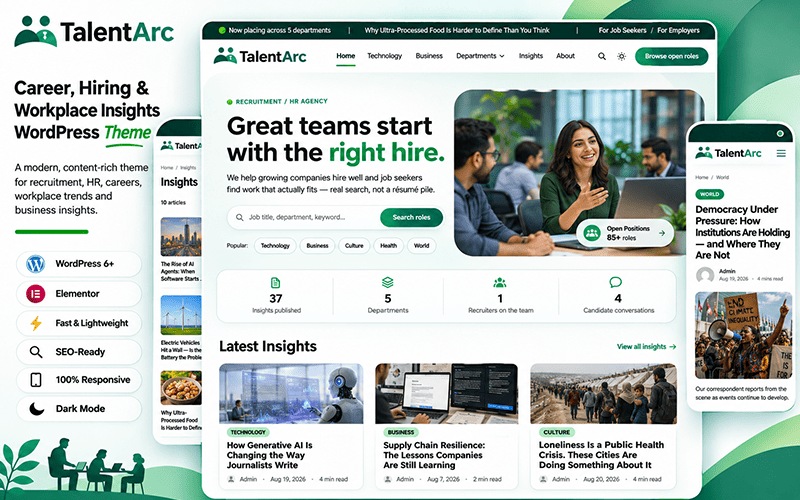
Description
CTRSpace Recruitment is a modern, responsive WordPress Recruitment Theme designed specifically for recruitment blogs, staffing industry publications, HR content creators, talent acquisition professionals, and recruitment agencies that share hiring knowledge through articles.
Recruitment is a constantly evolving field. Employers need guidance on attracting qualified candidates, recruiters need practical hiring strategies, and job seekers want reliable information about applications, interviews, and career development. CTRSpace Recruitment provides a professional publishing environment for these different audiences through organized, informative editorial content.
Built with Tailwind CSS v4, Alpine.js and Vanilla JavaScript, the theme combines clean typography, responsive layouts, an SEO-friendly publishing structure and a lightweight frontend architecture. Unlike conventional recruitment agency WordPress themes built primarily around job listings and application processing, CTRSpace Recruitment focuses on blogging and industry publishing. It does not operate an applicant tracking system, job portal or candidate-management database.
Whether you’re building a recruitment advice blog, publishing HR research, sharing hiring strategies or developing a career education publication, CTRSpace Recruitment gives your content a consistent professional home.
CTRSpace Recruitment At A Glance
| Feature | Details |
| Product Type | Recruitment Blogging WordPress Theme |
| Best For | Recruitment, HR, Hiring, Staffing & Career Content |
| Main Purpose | Blogging & Editorial Publishing |
| Job Board System | Not Included as a Native Function |
| Applicant Tracking System | No |
| Resume Database | No |
| Candidate Application Processing | No Native Application System |
| Responsive | 100% Responsive Design |
| Styling | Tailwind CSS v4 |
| Interactions | Alpine.js + Vanilla JavaScript |
| Typography | Inter Font, Loaded Locally |
| Animations | GSAP, Used Selectively |
| Sliders | Swiper.js, Where Required |
| SEO | SEO-Friendly Structure |
| Performance | Lightweight, Core Web Vitals-Focused Architecture |
| Platform | WordPress |
What Is CTRSpace Recruitment?
CTRSpace Recruitment is a Recruitment Blog WordPress Theme created for professionals and publishers who regularly produce articles about hiring, talent acquisition, human resources and career development.
It provides an editorial foundation for content such as:
- Recruitment strategies
- Hiring process guides
- Talent acquisition insights
- Candidate sourcing advice
- Interview preparation articles
- Resume and CV writing guides
- Job search education
- Employee recruitment trends
- Employer branding insights
- Staffing industry analysis
- Recruitment technology reviews
- Workplace and labor market research
- Diversity and inclusive hiring
- Graduate recruitment guidance
- Professional recruiter commentary
The theme is intended for publishing and presenting this information through WordPress articles and organized content categories.
It does not independently advertise vacancies, collect job applications, evaluate candidates or manage hiring pipelines.
Built For Recruitment Blogs
Recruitment publishing serves several audiences whose informational needs overlap but are not identical. An employer may want to understand how to improve candidate quality. A recruiter may be researching sourcing methods. An HR manager could be exploring interview consistency, while a job seeker may need practical advice about preparing for an interview. A useful recruitment publication should make these audiences and their questions easy to distinguish.
CTRSpace Recruitment supports a content-first approach that allows publishers to organize articles around hiring, recruiting, HR practices and career guidance. For example, an article about interview preparation could connect to a guide on competency-based interviews, while a recruitment strategy article might link to related content about sourcing, screening and candidate experience.
This editorial structure helps readers move from introductory advice to more specialized information.
Publish Recruitment Strategy Articles
Recruitment strategy content helps employers and hiring professionals understand how recruitment decisions affect business objectives. A useful strategy article should explain the hiring challenge, identify relevant constraints, and discuss approaches that may improve the process.
Publishers can cover subjects such as:
- Recruitment planning
- Hiring goals and workforce needs
- Candidate attraction methods
- Recruitment channel selection
- Hiring process improvement
- Talent pipeline development
- Recruitment budgeting
- Hiring performance measurement
For example, a guide to developing a recruitment strategy could explain how to define role requirements, understand the available labor market, select sourcing channels, and measure recruitment outcomes.
It could also discuss trade-offs between speed, cost, and candidate suitability. CTRSpace Recruitment provides a professional publishing foundation for presenting these practical explanations without representing the theme as recruitment management software.
Create Talent Acquisition Content
Recruitment and talent acquisition are closely related, but the subjects are not always interchangeable. Recruitment commonly addresses the process of filling vacancies. Talent acquisition often includes longer-term planning around skills, workforce capability, and future hiring needs. A talent acquisition publication may explore employer positioning, strategic sourcing, skills-based hiring, candidate relationships, and workforce planning.
These articles can help readers understand how short-term hiring decisions contribute to longer-term organizational goals. For example, a publication might compare reactive vacancy filling with building relationships among professionals who could become suitable candidates in the future. CTRSpace Recruitment is suitable for explaining these concepts through educational guides, professional analysis, and informed commentary.
Publish Hiring Process Guides
Hiring involves multiple decisions, and problems at one stage can affect the entire process. An unclear job description may attract unsuitable applicants. Inconsistent screening can create delays, while poorly structured interviews may make candidate comparisons difficult.
A recruitment blog can publish guides on each stage of the hiring process, including:
- Defining role requirements
- Writing clear job descriptions
- Selecting sourcing channels
- Reviewing candidate qualifications
- Designing interview processes
- Assessing job-relevant skills
- Communicating hiring decisions
- Improving the candidate experience
A detailed guide could explain how structured interviews use consistent, job-related questions and assessment criteria. It should also recognize that particular hiring practices may be subject to employment and anti-discrimination laws. CTRSpace Recruitment is suited to publishing this kind of substantial, process-oriented educational content.
Create Recruitment Agency Insights
Recruitment agencies operate in a competitive professional environment where expertise, industry specialization and market knowledge matter. Publishing valuable insights can help an agency communicate how it understands recruitment challenges without turning every article into a sales pitch.
A recruitment agency blog might cover:
- Recruitment market developments
- Candidate availability
- Specialist industry hiring
- Common employer challenges
- Recruitment process efficiency
- Candidate communication
- Workforce planning
- Lessons from recruitment practice
For example, a specialist technology recruitment agency could publish an analysis explaining how skill requirements differ between software engineering roles. A healthcare recruitment publisher might focus on qualification requirements, workforce challenges, and relevant professional development. CTRSpace Recruitment is designed for this editorial use case. It is suitable for agency publications, but it is not a replacement for the agency’s operational hiring systems.
Publish Staffing And Workforce Planning Articles
Staffing content often addresses workforce demand, employment arrangements and changing organizational requirements. Readers may want to understand how temporary staffing differs from permanent hiring or how workforce planning can help organizations prepare for future needs.
A staffing-focused blog can examine:
- Permanent and temporary recruitment
- Contract staffing considerations
- Seasonal workforce planning
- Skills shortages
- Workforce flexibility
- Staffing models
- Employee retention
- Recruitment capacity planning
These subjects require careful distinctions.
For example, an article comparing contract and permanent staffing should explain operational considerations, expected duration, relevant costs and jurisdiction-specific employment obligations. CTRSpace Recruitment offers an editorial foundation for sharing these explanations through professionally organized content.
Create HR And Human Resources Content
Recruitment is part of a broader employee lifecycle. An HR publication can connect hiring decisions with onboarding, employee development, workplace practices and retention.
CTRSpace Recruitment is suitable for articles covering:
- HR planning
- Employee onboarding
- Workplace communication
- Performance management
- Employee engagement
- Workplace culture
- Talent development
- Retention strategies
- HR technology
- Professional HR practices
For example, an article about onboarding could explain how role clarity, training, manager communication and early feedback contribute to the new employee experience. Such content is valuable because it connects recruitment outcomes with what happens after a candidate joins an organization. Publishers should identify the relevant legal jurisdiction when discussing employment policies or regulatory responsibilities.
Publish Career Advice And Job Search Guides
Recruitment publications can also serve job seekers who need practical, accurate guidance. Career-focused articles should help readers understand hiring processes and present their experience clearly.
Relevant subjects include:
- Resume and CV preparation
- Cover letters
- Interview preparation
- Professional networking
- Career transitions
- Job search planning
- Workplace skills
- Portfolio development
- Career progression
- Employment offer evaluation
A useful resume-writing guide might explain how to present relevant accomplishments, tailor experience to role requirements, and avoid misleading qualifications. An interview article could help candidates prepare evidence-based examples of their experience instead of encouraging memorized answers. CTRSpace Recruitment provides a blogging foundation for organizing these educational resources. It does not independently accept or process job applications.
Create Interview Preparation Content
Interview preparation deserves dedicated editorial coverage because employers and candidates approach interviews from different perspectives. Candidates need to understand what an employer may be assessing and how to communicate relevant experience. Recruiters and hiring managers need to develop fair, consistent, and job-related evaluation methods.
A recruitment blog can publish separate resources for these audiences. Candidate-focused guides may explain behavioral interview questions, skills assessments, remote interview preparation, and follow-up communication. Employer-focused articles may explore structured interviews, evaluation criteria, panel consistency, and reducing irrelevant bias. Separating these perspectives makes the content more useful and avoids presenting every interview process as identical.
Publish Graduate Recruitment And Early Career Guides
Graduate recruitment creates particular challenges for both employers and early-career candidates. Employers may need to evaluate potential when applicants have limited professional experience. Graduates may struggle to explain transferable skills or understand what different roles require.
A specialist publication can address:
- Graduate hiring processes
- Entry-level recruitment
- Internship applications
- Apprenticeship pathways
- Transferable skills
- Early career interviews
- Career readiness
- Professional development
For example, an article about assessing graduate applicants could discuss work samples, structured interviews, and role-relevant capabilities rather than relying exclusively on previous employment history. Publishers should avoid suggesting that any single hiring method guarantees successful recruitment.
Cover Remote And Hybrid Recruitment
Hiring across locations introduces additional considerations for employers and candidates. Remote recruitment may involve virtual interviews, time-zone coordination, identity verification, communication practices, and location-specific employment requirements. A recruitment publisher can examine how these factors affect hiring quality and candidate experience.
Articles might explain how to structure a remote interview, communicate work-location expectations or assess collaboration skills using job-relevant evidence. Remote work should not be presented as a single arrangement with universal rules. Employment obligations, compensation practices and work eligibility can differ by country, region and employer.
CTRSpace Recruitment supports educational publishing around these subjects while keeping legal and regulatory responsibilities with the content publisher and relevant professionals.
Publish Recruitment Technology And AI Insights
Recruitment technology is an important editorial topic for staffing professionals and HR teams. Recruitment software may assist with sourcing, scheduling, application tracking, assessment, and reporting. AI-related tools can also introduce questions about data quality, transparency, accuracy, bias, and human oversight.
A recruitment technology blog can publish:
- Applicant tracking software reviews
- Recruitment technology comparisons
- AI in talent acquisition
- Recruitment automation analysis
- Interview scheduling tools
- Candidate assessment technologies
- Hiring analytics
- Recruitment data privacy
- HR software developments
A software comparison should distinguish verified product capabilities from vendor marketing claims.
Where automated systems influence candidate screening or evaluation, authors should consider relevant legal and ethical requirements. CTRSpace Recruitment can publish reviews and analysis of these technologies, but it does not itself contain an applicant tracking system or AI candidate-matching engine.
Cover Recruitment Trends And Labor Market Research
Recruitment practices are influenced by changing labor market conditions, workforce expectations, technology and employer demand. A useful industry publication can help readers interpret these developments. Recruitment trend articles may explore hiring activity, occupational skill demand, recruitment challenges, working arrangements and changes in workforce participation.
However, market conditions vary by industry, location and time. A claim about increasing hiring demand should identify the relevant market, measurement period, and supporting evidence. Similarly, salary and employment statistics should be clearly attributed to reliable sources. CTRSpace Recruitment provides a publishing foundation for this type of research-based editorial content.
Publish Diversity And Inclusive Hiring Insights
Recruitment publications may cover methods for making hiring practices more consistent, accessible, and job-related. This subject requires thoughtful explanations rather than broad claims. Relevant content may discuss accessible applications, structured assessments, inclusive job descriptions, and evaluating candidates using relevant skills.
For example, an article about interview accessibility might explain the importance of communicating the interview format clearly and considering reasonable accommodations where applicable. Authors should avoid presenting general educational commentary as legal advice. Employment and anti-discrimination requirements vary between jurisdictions, so regulatory claims should reference current authoritative sources.
Build Recruitment Topic Clusters
As a recruitment publication grows, a clear editorial structure helps different audiences find relevant information.
A recommended content architecture includes:
| Category | Editorial Focus |
| Recruitment Strategies | Hiring plans, sourcing methods and recruitment effectiveness |
| Talent Acquisition | Long-term talent planning, employer branding and skills-based hiring |
| Hiring Process | Job descriptions, screening, interviews and selection |
| HR & Workplace | Onboarding, retention and people-management practices |
| Career Advice | Resume writing, job searches and professional development |
| Staffing Insights | Workforce models, temporary staffing and industry challenges |
| Recruitment Technology | ATS comparisons, hiring software and AI developments |
| Industry Research | Labor market analysis, recruitment trends and research |
The categories should be adapted to the publication’s actual audience.
Useful internal linking relationships might include:
Recruitment Strategy → Candidate Sourcing → Candidate Screening → Structured Interviews
Or:
Career Planning → Resume Preparation → Job Applications → Interview Preparation
These relationships help readers progress through related subjects rather than navigating a collection of disconnected posts.
Professional Editorial Design
Recruitment content often combines practical guidance with industry-specific terminology and professional analysis. A clear editorial design helps readers understand detailed information without unnecessary visual distractions.
CTRSpace Recruitment emphasizes:
- Readable typography
- Logical heading hierarchy
- Professional article presentation
- Organized content categories
- Clear navigation
- Balanced spacing
- Responsive layouts
- Comfortable long-form reading
This approach is appropriate for both brief recruitment commentary and comprehensive hiring guides. A consistent visual presentation also helps a publication maintain its identity across articles written for recruiters, employers, and job seekers.
Designed For Detailed Recruitment Content
Recruitment education may require more than ordinary paragraphs. A hiring guide can explain a process through numbered steps. A software review may use comparison tables, while a labor market article may include charts and cited statistics.
Appropriate content formats include:
- Recruitment process explanations
- Hiring checklists
- Interview guides
- Comparison tables
- Research summaries
- Career tutorials
- Professional case studies
- Step-by-step resources
- Definitions and terminology
- Supporting images and charts
Specific content elements depend on the WordPress editor, implemented theme styles and any additional tools. Publishers should avoid including confidential candidate information or identifiable recruitment records without appropriate authorization.
100% Responsive Design
CTRSpace Recruitment follows a 100% responsive design approach. Its layouts are intended to adapt across desktops, laptops, tablets, smartphones and modern screen sizes. Responsive presentation matters for recruitment publishing because professionals and job seekers may research career information during commutes, breaks or while using mobile devices.
The theme is designed to maintain readable typography and consistent content hierarchy across screen sizes.
Performance-Focused Architecture
CTRSpace Recruitment uses a frontend stack built around:
- Tailwind CSS v4
- Alpine.js
- Vanilla JavaScript
- Locally hosted Inter font
- Selective GSAP animations
- Swiper.js where required
The architecture is intended to support professional design and purposeful interface behavior without unnecessary frontend complexity. Performance can affect how comfortably visitors access extensive hiring guides or research articles. Actual website performance also depends on hosting, images, caching, plugins and third-party services.
Core Web Vitals-Focused Foundation
CTRSpace Recruitment is developed with performance principles relevant to Core Web Vitals. These include stable page layouts, efficient styling, responsive visual elements and controlled JavaScript interactions. Important measurements include Largest Contentful Paint, Interaction to Next Paint, and Cumulative Layout Shift.
Real-world results depend on the completed website and should be evaluated through appropriate performance testing. No specific speed score or search ranking is guaranteed.
Built With Tailwind CSS V4
Tailwind CSS v4 serves as the primary styling system. It supports consistency across typography, spacing, responsive layouts and editorial components. For a recruitment publication, consistent styling helps maintain a cohesive presentation across articles about HR, interviews, industry research and career development.
Lightweight Interactions With Alpine.Js
Alpine.js is used for lightweight frontend behavior. It is suitable for focused interface elements such as dropdown navigation, toggles, tabs, and expandable controls where implemented. The objective is to support useful interactions without replacing the publishing experience with an unnecessarily complex application interface.
Vanilla JavaScript
Vanilla JavaScript handles additional frontend behavior that does not require Alpine.js. This helps keep custom interactions focused and limits unnecessary dependencies. The use of JavaScript does not imply that the theme includes candidate matching, job application processing or recruitment automation.
Locally Hosted Inter Font
CTRSpace Recruitment uses the Inter font, loaded locally. Its professional appearance supports clear presentation of hiring guides, career articles, analytical content, and recruitment terminology. Local font hosting also reduces dependence on third-party font delivery services.
Selective GSAP Animations
GSAP may be used selectively where motion improves the interface. For recruitment publishing, animations should support navigation or visual understanding without distracting readers from important professional information.
Swiper.Js Where Required
Swiper.js is used for slider or carousel functionality where required by the implemented design. For example, selected editorial stories may be highlighted using a carousel when that presentation helps content discovery.
SEO-Friendly Recruitment WordPress Theme
CTRSpace Recruitment provides an SEO-friendly editorial foundation for hiring, recruitment, and career-focused content. A recruitment publication should distinguish between informational searches and searches for actual job vacancies. Someone searching for interview preparation expects educational guidance. Someone searching for a vacancy expects an accessible, current job listing. CTRSpace Recruitment is designed primarily for the first type of publishing activity: helpful recruitment articles, HR resources, industry insights, and career guidance.
An effective editorial SEO approach includes:
- Descriptive article titles
- Clear and meaningful headings
- Original professional insights
- Relevant content categories
- Contextual internal links
- Accurate source references
- Descriptive image text
- Credible author information
- Content reviews when information changes
WordPress and compatible SEO tools can support metadata and structured data where properly configured. The theme does not guarantee search rankings, traffic or appearance in specialized Google search experiences.
Built For Direct Recruitment Answers
Recruitment readers often search for specific explanations.
A publication can create articles answering questions such as:
- What is talent acquisition?
- How does recruitment differ from talent acquisition?
- What is candidate sourcing?
- How does structured interviewing work?
- What is an applicant tracking system?
- How can employers improve candidate experience?
- What should candidates include in a resume?
- How do competency-based interviews work?
- What is skills-based hiring?
- How can organizations measure recruitment effectiveness?
A useful article should answer the core question clearly before exploring examples, limitations, and practical considerations. CTRSpace Recruitment provides an editorial setting for developing these connected educational resources.
Support Professional Author Credibility
Recruitment advice may influence employment decisions and professional opportunities. Readers should understand who is providing guidance and what experience or evidence supports it. Authors may communicate their professional role, recruitment expertise, industry specialization, and relevant qualifications. WordPress provides author-based publishing functionality; the precise presentation of author information depends on the theme’s implemented templates. Credentials and professional achievements should be accurate and verifiable.
Recruitment Content Requires Accuracy And Fairness
Hiring and employment content can affect people’s careers and livelihoods. Publishers should take particular care when discussing employment law, applicant assessment, equal opportunity requirements, salary information and workplace rights.
Good editorial practice includes:
- Citing authoritative sources
- Identifying relevant jurisdictions
- Checking employment statistics
- Avoiding discriminatory generalizations
- Protecting candidate privacy
- Explaining uncertainty and limitations
- Reviewing time-sensitive regulations
- Distinguishing educational content from professional legal advice
For example, an interview guide should not suggest that a hiring question is universally lawful merely because it is common in a particular region. Responsible recruitment publishing requires context and accuracy.
What Makes CTRSpace Recruitment Different?
Built Specifically For Recruitment Blogging
Focused on recruitment education, hiring insights, and professional editorial content rather than operating job listings and application systems.
Recruitment Strategy Publishing
Suitable for detailed guidance on hiring planning, sourcing methods and recruitment improvement.
HR And Talent Acquisition Coverage
Provides a consistent publishing foundation for HR knowledge, talent planning and workforce insights.
Career Advice Focused
Appropriate for resume guides, interview preparation and professional development content.
Recruitment Technology Editorial Content
Suitable for software comparisons, hiring technology commentary and AI-related recruitment analysis.
Research And Industry Insights
Supports evidence-based articles about labor market developments, workplace practices and staffing trends.
Professional Editorial Design
A clean, readable presentation suited to professional recruitment and career-focused audiences.
Responsive, Performance-Conscious Architecture
Developed using modern frontend technology with a focus on efficient publishing experiences.
Key Features
- Recruitment Blogging WordPress Theme
- Recruitment Agency Blog Publishing
- Hiring Strategy Articles
- Talent Acquisition Content
- HR and Workplace Insights
- Career Advice Guides
- Interview Preparation Resources
- Candidate Sourcing Articles
- Resume and CV Education
- Staffing Industry Analysis
- Graduate Recruitment Content
- Remote Hiring Insights
- Recruitment Technology Reviews
- AI Recruitment Commentary
- Labor Market Research
- Long-Form Editorial Publishing
- Category-Based Content Organization
- WordPress Author-Based Publishing
- 100% Responsive Design
- SEO-Friendly Structure
- Core Web Vitals-Focused Architecture
- Tailwind CSS v4
- Alpine.js
- Vanilla JavaScript
- Locally Hosted Inter Font
- Selective GSAP Support
- Swiper.js Where Required
Who Should Use CTRSpace Recruitment?
CTRSpace Recruitment is suitable for:
- Recruitment bloggers
- Recruitment agencies publishing educational content
- Staffing industry writers
- HR professionals
- Talent acquisition specialists
- Independent recruiters
- Career advice bloggers
- Interview coaches publishing educational guides
- Recruitment consultants
- Workforce analysts
- Employment industry journalists
- Recruitment technology reviewers
- Graduate career educators
- Employer branding writers
- Multi-author HR publications
The theme is particularly suitable for individuals and organizations whose primary goal is sharing recruitment knowledge through articles.
Frequently Asked Questions
Is CTRSpace Recruitment a blogging WordPress theme?
Yes. CTRSpace Recruitment is designed specifically for recruitment-related blogging and editorial publishing.
Can recruitment agencies use this WordPress theme?
Yes. Recruitment agencies can use it to publish hiring guides, market insights, professional commentary, and educational recruitment content. It is not designed as a complete agency management platform.
Does the theme include a job board?
No native job board functionality is claimed. CTRSpace Recruitment focuses on blogging and editorial publishing.
Can candidates apply for jobs through the theme?
The theme does not include a native job application processing system. Application workflows require separate functionality.
Does CTRSpace Recruitment include an applicant tracking system?
No. It does not provide an ATS, candidate database, or recruitment pipeline management software.
Can I publish recruitment strategy articles?
Yes. Hiring methods, candidate sourcing, recruitment planning, and talent acquisition are suitable editorial topics.
Can I create an HR blog?
Yes. The theme is suitable for HR guides, workplace insights, employee development articles, and related professional publishing.
Can I publish resume and interview advice?
Yes. CV writing, job applications, interview preparation, and career development are relevant educational subjects.
Is the theme suitable for recruitment technology reviews?
Yes. Recruitment software comparisons, ATS reviews, hiring automation discussions and AI-related recruitment articles can be published as editorial content.
Can I publish labor market research?
Yes. Research summaries, industry analysis, and employment trend articles fit the theme’s publishing purpose. Statistics and claims should be supported by reliable sources.
Can I publish content for employers and job seekers?
Yes. Both audiences can be served through clearly organized content categories and relevant articles.
Is CTRSpace Recruitment responsive?
Yes. It follows a 100% responsive design approach intended for desktop, tablet and mobile devices.
Is this WordPress recruitment theme SEO friendly?
Yes. CTRSpace Recruitment is designed with an SEO-friendly editorial approach. Actual search performance depends on website configuration, content quality, competition and wider SEO practices.
What technologies are used?
CTRSpace Recruitment uses Tailwind CSS v4, Alpine.js, Vanilla JavaScript and locally hosted Inter typography. GSAP and Swiper.js are used selectively where required by the implemented design.
Is the theme suitable for long-form articles?
Yes. It is suitable for detailed recruitment guides, career resources, professional research and analytical content.
There are no reviews yet.