
Description
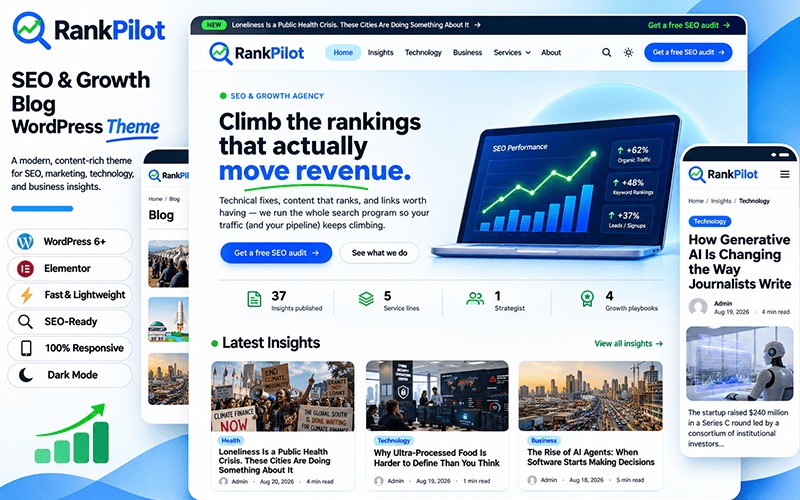
CTRSpace SEO is a modern, responsive WordPress SEO Theme designed specifically for search engine optimization blogs, SEO educators, independent consultants, search marketing professionals, and editorial teams publishing expertise about organic search. Search engine optimization involves more than choosing keywords or adjusting page titles. Readers need practical guidance on crawling, indexing, technical performance, search intent, content architecture, internal linking, and measuring organic visibility.
CTRSpace SEO provides an organized publishing environment for explaining these subjects through educational articles, technical guides, original research, professional commentary and detailed case studies. Built with Tailwind CSS v4, Alpine.js, and Vanilla JavaScript, the theme combines a clean, professional design with responsive layouts, locally hosted Inter typography, and a performance-conscious frontend architecture.
It is designed for WordPress blogging and editorial publishing, not as an automated SEO audit tool, rank tracker, backlink platform, or agency management system. Whether you’re building an independent SEO publication, sharing lessons from professional projects or developing a learning resource for website owners, CTRSpace SEO provides a consistent foundation for presenting search marketing knowledge.
CTRSpace SEO At A Glance
| Feature | Details |
| Product Type | SEO Blogging WordPress Theme |
| Best For | SEO Tutorials, Search Insights, Technical Guides & Case Studies |
| Main Purpose | Blogging & Editorial Publishing |
| Built-In Keyword Research Tool | No |
| Automated SEO Auditing | No |
| Rank Tracking Platform | No |
| Backlink Analysis Software | No |
| Responsive | 100% Responsive Design |
| Styling | Tailwind CSS v4 |
| Interactions | Alpine.js + Vanilla JavaScript |
| Typography | Inter Font, Loaded Locally |
| Animations | GSAP, Used Selectively |
| Sliders | Swiper.js, Where Required |
| SEO | SEO-Friendly Editorial Structure |
| Performance | Lightweight, Core Web Vitals-Focused Architecture |
| Platform | WordPress |
What Is CTRSpace SEO?
CTRSpace SEO is an SEO Blog WordPress Theme created for publishers who regularly produce educational, analytical, and research-based content about search engine optimization.
The theme is suitable for publishing:
- SEO fundamentals and beginner guides
- Keyword research tutorials
- Search intent analysis
- On-page SEO strategies
- Technical SEO explanations
- Crawling and indexing guides
- Internal linking advice
- Content optimization resources
- Core Web Vitals education
- Local SEO articles
- SEO case studies
- Search performance analysis
- Search algorithm updates
- SEO software reviews
- Professional SEO commentary
Its primary role is to present articles, organize related subjects, and support a consistent editorial identity. CTRSpace SEO does not directly analyze websites, discover keywords, monitor backlinks, or submit URLs to search engines. Those activities require separate services, software, or WordPress integrations.
Built For SEO Blogs
SEO readers rarely have the same knowledge or objectives. A beginner may want to understand how search engines work, while an experienced specialist may be researching JavaScript rendering, crawl behavior, or structured data implementation. A small business owner might need guidance on local visibility, while a publisher could be investigating why previously successful content has lost organic traffic.
A dedicated SEO publication should accommodate these differences without becoming difficult to navigate. CTRSpace SEO is well-suited to organizing introductory articles, specialist tutorials, industry analysis, and professional research into clear topic areas. For example, a beginner guide to indexing can lead readers toward more detailed articles about canonical URLs, robots directives, and sitemap management.
This gives publishers an opportunity to develop connected learning resources rather than isolated articles that repeatedly explain the same concepts.
Publish Keyword Research Guides
Keyword research is one of the most widely discussed subjects in SEO, but effective research involves more than collecting search-volume figures. A useful keyword research guide should explain how to interpret search demand, evaluate search intent, and decide whether a topic fits the publication’s audience.
CTRSpace SEO is suitable for educational articles about:
- Keyword discovery methods
- Search volume interpretation
- Keyword difficulty estimates
- Commercial and informational intent
- Long-tail keyword research
- Keyword clustering
- Topic prioritization
- Keyword mapping
- Search result analysis
For example, a tutorial could explain why a broad keyword with high search volume may be less suitable for a specific product page than a lower-volume query expressing clearer purchase intent. An advanced guide might demonstrate how to group related queries under one page instead of creating separate pages with substantially overlapping information.
These explanations give readers a framework for making decisions rather than treating keyword research as a mechanical process.
Create On-Page SEO Tutorials
On-page SEO concerns the content and page-level elements that help visitors and search systems understand a webpage. A focused SEO publication can explain how titles, headings, internal links, and relevant content fit together.
Suitable tutorial subjects include:
- Title elements and snippets
- Heading hierarchy
- Search intent alignment
- Descriptive URLs
- Internal linking
- Image alternative text
- Content relevance
- Duplicate and overlapping pages
- Page structure
- Content maintenance
A useful article about headings, for example, can demonstrate how descriptive sections improve navigation and comprehension without claiming that an arbitrary number of keywords in H2 tags guarantees better rankings. CTRSpace SEO provides a professional editorial setting for publishing practical on-page optimization guides supported by examples.
Publish Technical SEO Content
Technical SEO involves making content accessible and understandable to search systems while providing a reliable website experience. Many technical subjects require careful distinctions. Crawling is not the same as indexing. A canonical URL is a signal about the preferred version of a page, not a command that automatically guarantees the desired search result. A sitemap can help discovery but does not ensure every URL will be indexed.
CTRSpace SEO is suitable for publishing articles covering:
- Website crawling
- Indexing and indexability
- Canonicalization
- XML sitemaps
- Robots.txt and robots directives
- HTTP status codes
- Redirects
- JavaScript rendering
- Structured data
- International SEO
- Website migrations
For example, a guide about an accidentally deindexed page could explain how to examine indexing directives, HTTP responses, canonical signals and relevant Search Console information. Technical tutorials should describe the conditions under which a recommendation applies and avoid presenting complex solutions as universal fixes.
Explain Website Performance And Core Web Vitals
Website performance influences how comfortably visitors interact with content. For SEO publishers, speed and user experience deserve careful technical coverage because several performance metrics are commonly misunderstood.
CTRSpace SEO can host articles explaining:
- Largest Contentful Paint (LCP)
- Interaction to Next Paint (INP)
- Cumulative Layout Shift (CLS)
- Image loading
- JavaScript execution
- Font loading
- Render-blocking resources
- Caching
- Real-user performance data
- Laboratory testing
A useful Core Web Vitals article can distinguish between controlled tests and measurements collected from actual visitors. It can also explain why a PageSpeed Insights score is not interchangeable with the full experience of every user.
CTRSpace SEO’s own frontend is developed with performance-conscious principles, but actual Core Web Vitals performance depends on implementation, hosting, plugins, media and third-party resources.
Create SEO Content Strategy And Topical Authority Guides
Search-focused content planning requires understanding which topics matter to the intended audience and how individual articles relate to one another. Publishing numerous similar articles does not automatically create a useful resource. An effective SEO content strategy identifies important questions, establishes logical content relationships, and provides enough information to satisfy each reader’s purpose.
A specialist publication may cover:
- Content planning
- Audience research
- Topic clusters
- Content briefs
- Search intent mapping
- Content consolidation
- Internal linking strategies
- Editorial review
- Content audits
- Publication structure
For example, a guide to topic clustering could demonstrate how one comprehensive technical SEO resource connects to specialized tutorials about redirects, canonicals, indexing, and structured data. CTRSpace SEO offers the publishing environment for developing these resources, while the publisher remains responsible for research, editorial decisions, and content quality.
Publish Link Building And Digital PR Education
Links remain an important subject in SEO education, but publishers should explain the difference between legitimate editorial references and manipulative link acquisition. A useful publication can cover link earning, digital public relations, citation practices, and the evaluation of backlink information.
Articles may explore:
- Editorial link acquisition
- Original research as a reference resource
- Digital PR campaigns
- Relevant industry publications
- Brand mentions
- Backlink analysis concepts
- Link attributes
- Outreach quality
- Link spam risks
For example, an educational guide could explain how original data, practical resources, or genuinely newsworthy information may attract voluntary references from other websites. It should not promise guaranteed rankings or encourage practices designed primarily to manipulate search signals.
CTRSpace SEO provides a platform for publishing responsible link-building education, not a backlink marketplace or automated link creation tool.
Publish Local SEO Guides
Local SEO has distinct informational needs because businesses often want to understand visibility within specific geographic markets. A local SEO publication may cover Google Business Profile, local landing pages, business information consistency, reviews, and location-specific search intent.
For example, an article about multi-location SEO could explain why individual location pages should contain genuinely useful, location-relevant information instead of nearly identical text with city names replaced.
Other resources might explain how service-area businesses differ from physical storefronts or how to interpret business profile performance. CTRSpace SEO can host this educational material without functioning as a local listing management application. Publishers should reference current platform rules when discussing business profiles or location eligibility.
Create Ecommerce And Product SEO Content
Ecommerce websites introduce SEO considerations that may differ from those of ordinary blogs. Product variants, category pages, inventory changes, faceted navigation and product information can create complicated indexing and content challenges.
CTRSpace SEO is suitable for educational articles explaining:
- Product page optimization
- Ecommerce category structure
- Faceted navigation
- Duplicate product URLs
- Product structured data
- Merchant-related search features
- Inventory and discontinued products
- Internal linking for large catalogs
A guide about product variations could explain the importance of consistent canonicalization and appropriate structured data according to the site’s implementation. This is an editorial publishing use case. CTRSpace SEO is not being presented as an ecommerce shop or product catalog system.
Publish SEO Case Studies
Case studies can demonstrate how SEO methods are applied to real websites. However, a successful case study should show more than a before-and-after traffic chart.
A useful SEO case study can document:
- Website context: The type of website, target audience, and relevant market.
- Initial challenge: The technical, content, or visibility problem being investigated.
- Starting measurements: Relevant baseline information and dates.
- Research and diagnosis: The evidence considered before making changes.
- Actions implemented: The actual technical or editorial work.
- Observed results: Measurable changes over a defined period.
- Limitations: Other factors that could have influenced the outcome.
For example, a migration case study could explain how URL mappings, redirects, canonical signals, and post-launch monitoring were managed. A responsible analysis should distinguish correlation from proven causation. CTRSpace SEO provides a blogging foundation for presenting this research in detailed articles. It does not generate SEO case studies or automatically connect to analytics services.
Publish SEO Tools And Software Reviews
SEO professionals use different tools for crawling, search performance analysis, keyword research, rank monitoring, and content evaluation. A specialist blog can help readers compare these products based on actual requirements.
Relevant review categories include:
- Website crawlers
- Keyword research platforms
- Rank tracking tools
- Backlink analysis tools
- Technical auditing software
- Content research products
- Reporting software
- Local SEO tools
- Search analytics platforms
A useful tool comparison should consider functionality, limitations, supported data, pricing, and intended users. A technical SEO consultant auditing a large website may need different capabilities from an independent blogger conducting occasional keyword research. Publishers should clearly distinguish firsthand testing from vendor documentation and disclose material affiliate or sponsorship relationships.
Cover Search Engine Updates And Industry Research
Search systems change over time, and SEO publishers frequently need to interpret announcements, documentation changes, and observed trends.
CTRSpace SEO is suitable for publishing industry news and expert commentary about:
- Search engine documentation
- Ranking system announcements
- Search interface changes
- Search Console updates
- Indexing developments
- Structured data policy changes
- Spam policies
- AI-assisted search experiences
- Search industry research
News coverage should distinguish official statements from independent observations. For example, a ranking fluctuation observed by several website owners is not necessarily evidence of a confirmed algorithm update. Authors should identify publication dates, evidence, and meaningful uncertainty when discussing changing search behavior.
Create AI Search And Answer Engine Optimization Content
AI-assisted search experiences introduce new questions about content discovery, attribution, summarization, and publisher visibility. An SEO publication can explore these subjects without promising placement in AI-generated responses.
Useful topics include:
- AI-powered search interfaces
- Content clarity and interpretability
- Search result attribution
- Technical accessibility
- Original evidence and expertise
- Structured content
- AI search measurement limitations
- Publisher visibility
For example, a guide might explain why clear answers, original supporting evidence and accessible page content remain valuable for readers regardless of the interface used to discover information. Claims about AI visibility should be grounded in published documentation or clearly labeled experiments. CTRSpace SEO supports publishing this analysis; it does not guarantee mentions, citations, or rankings in AI search systems.
Create SEO Tutorials For WordPress Users
WordPress users often need guidance on the relationship between themes, plugins, hosting, content, and technical SEO.
A WordPress-focused SEO publication can explain:
- Permalink planning
- Indexing settings
- Category and tag archives
- XML sitemaps
- SEO plugin configuration
- Image optimization
- Theme changes
- Redirect management
- Author and archive pages
- Site performance
For example, a guide about changing WordPress themes could explain why publishers should review template markup, navigation, internal links, performance, structured data, and page rendering before and after the change. This type of content is especially relevant to a brand selling WordPress blogging themes.
It helps users distinguish what a theme provides from what must be configured through WordPress, plugins, or external services.
Build SEO Topic Clusters
A structured SEO publication should guide readers from basic concepts toward advanced learning.
An example content architecture includes:
| Editorial Category | Content Focus |
| SEO Fundamentals | Search concepts, terminology and beginner guides |
| Keyword Research | Search intent, keyword mapping and topic discovery |
| On-Page SEO | Titles, headings, internal linking and content optimization |
| Technical SEO | Crawling, indexing, canonicals, rendering and redirects |
| Content Strategy | Topic planning, editorial workflows and content improvement |
| Link Building | Editorial links, digital PR and backlink education |
| Local SEO | Business profiles and location-focused search |
| Ecommerce SEO | Product pages, categories and ecommerce architecture |
| SEO Tools | Software reviews and comparisons |
| Search News | Official updates, research and professional commentary |
A coherent structure also creates opportunities for contextual internal linking.
For example:
Technical SEO → Crawling → Indexing → Canonicalization → Search Console Analysis
Or:
Keyword Research → Search Intent → Topic Mapping → Content Briefs → On-Page SEO
These relationships should be based on genuine reader needs rather than artificial attempts to increase the number of internal links.
Professional Editorial Design
SEO articles often combine technical terminology, examples, screenshots and detailed analysis. A professional editorial presentation should help readers distinguish explanations, evidence, practical steps and limitations.
CTRSpace SEO emphasizes:
- Clear typography
- Logical content hierarchy
- Readable long-form articles
- Organized categories
- Consistent visual spacing
- Responsive layouts
- Straightforward content navigation
- Professional article presentation
A reader following a technical tutorial should be able to move through its steps without unnecessary distractions. Likewise, an experienced professional examining a case study should be able to locate methodology and results without searching through unrelated promotional material.
Designed For Technical And Data-Rich SEO Content
SEO education frequently involves presenting structured information. An article may contain search performance examples, keyword tables, index coverage screenshots, or technical markup explanations.
Useful publishing formats include:
- Step-by-step tutorials
- Comparison tables
- Screenshots
- Code excerpts
- SEO checklists
- Data examples
- Case-study timelines
- Definitions
- Research citations
- Process explanations
WordPress supports a range of editorial content formats, although the exact appearance of specialized elements depends on the site’s editor, plugins and implemented theme styling. Publishers should ensure that sensitive analytics information and client data are removed or shared only with proper authorization.
100% Responsive Design
CTRSpace SEO follows a 100% responsive design approach for desktops, laptops, tablets, and smartphones. This is particularly important for instructional content that readers may discover on mobile before returning to complete more detailed work on desktop. Layouts and typography are intended to adapt to modern screen sizes.
Wide comparison tables, screenshots, and code examples should be tested in the finished website to confirm they remain usable on smaller screens.
Performance-Focused Architecture
CTRSpace SEO uses a focused frontend stack built around Tailwind CSS v4, Alpine.js, Vanilla JavaScript, and locally hosted Inter typography. Selective GSAP animations and Swiper.js components are used where required by the implemented design.
The frontend approach aims to support professional presentation without unnecessary complexity. For an SEO-oriented publication, practical site performance matters because the audience may pay particular attention to loading behavior, visual stability and responsiveness.
Actual results depend on the complete website configuration, including hosting, plugins, caching, images and third-party scripts.
Core Web Vitals-Focused Foundation
CTRSpace SEO is developed with performance principles relevant to Core Web Vitals.
These include:
- Efficient loading of important page content
- Stable layout behavior
- Responsive user interactions
- Controlled JavaScript execution
- Appropriate media sizing
- Purposeful animation use
Largest Contentful Paint, Interaction to Next Paint, and Cumulative Layout Shift should be evaluated through appropriate testing. A lightweight design approach is useful, but it does not automatically establish that a website passes every performance threshold. Specific Core Web Vitals results and Google rankings cannot be guaranteed by the theme.
Built With Tailwind CSS V4
Tailwind CSS v4 serves as the theme’s primary styling system. It supports consistent typography, spacing, responsive design and editorial component presentation. This is valuable for an SEO publication containing different types of articles, from introductory tutorials to specialist technical research. A consistent visual system helps those resources feel like part of a coherent professional publication.
Lightweight Interactions With Alpine.Js
Alpine.js is used for focused frontend interactions. Depending on the implemented design, it can support navigation dropdowns, toggles, expandable content and other lightweight interface behaviors. This approach is intended to provide useful interactivity without introducing an unnecessarily large frontend framework.
Vanilla JavaScript
Vanilla JavaScript is used for additional interface behavior that does not require Alpine.js. It helps keep custom frontend functionality controlled and focused. The presence of JavaScript does not mean the theme includes SEO auditing, automated keyword discovery, or rank tracking.
Locally Hosted Inter Font
CTRSpace SEO uses the Inter font, hosted locally. Its modern typography is suited to professional articles, technical explanations, and detailed analytical content. Local hosting also reduces dependence on external font delivery services.
Selective GSAP Animations
GSAP can be used selectively where motion improves the interface. Animations should not distract from technical information, disrupt accessibility, or interfere with the reading experience.
Swiper.Js Where Required
Swiper.js is used where the implemented design requires sliders or carousels. Featured articles and selected editorial resources may be presented in carousel format where this improves content discovery. Such components should remain purposeful and accessible.
SEO-Friendly WordPress Theme For Blogging
CTRSpace SEO provides an SEO-friendly editorial foundation, but a clear distinction is necessary between theme architecture and the complete SEO process. A WordPress theme influences the structure, layout, and presentation of website content. Search visibility also depends on technical configuration, content quality, internal linking, site accessibility, search engine policies, and competitive conditions.
A publishing-focused theme should therefore support:
- Understandable page structures
- Readable navigation
- Clear content hierarchy
- Responsive presentation
- Efficient frontend behavior
- Accessible links and controls
- Consistent article organization
Metadata management, XML sitemaps, canonical configuration, and structured data may involve WordPress functionality, dedicated SEO plugins, or additional implementation. CTRSpace SEO should be considered part of the website’s search-friendly foundation, not a substitute for a complete SEO strategy.
Built For Direct SEO Answers
SEO readers frequently search for precise explanations.
A publication can develop resources answering questions such as:
- What is technical SEO?
- How do search engines crawl websites?
- What is the difference between crawling and indexing?
- How does canonicalization work?
- What is search intent?
- How should internal links be organized?
- What are Core Web Vitals?
- What does a 301 redirect do?
- How can Search Console help diagnose indexing issues?
- Does changing a WordPress theme affect SEO?
A useful answer should provide a clear explanation before introducing advanced details, exceptions, and examples. For instance, an article about canonical tags should explain their purpose and limitations rather than suggesting that adding a canonical tag automatically fixes every duplicate-content problem.
Support Professional SEO Author Credibility
SEO guidance can influence website architecture, content investments, and business decisions. Readers benefit from knowing whether the author has relevant professional experience, has performed testing or is interpreting publicly available documentation.
Publishers may use WordPress author information to communicate:
- Professional SEO experience
- Technical specializations
- Relevant certifications
- Research interests
- Documented case studies
- Editorial responsibilities
The precise appearance of author information depends on the implemented theme templates. Claims about professional achievements, rankings and client outcomes should be accurate and verifiable.
Keep SEO Content Accurate And Current
Search engines update documentation, interfaces and systems over time. An article about Search Console may become outdated after an interface change, while technical guidance may need revision as web standards and search engine capabilities evolve.
SEO publishers should:
- Reference authoritative documentation
- Explain the context of recommendations
- Distinguish verified facts from hypotheses
- Date time-sensitive research
- Update outdated instructions
- Avoid guaranteed ranking claims
- Check technical examples
- Review screenshots and external references
Authors should not describe speculation about algorithms as confirmed search engine behavior. A strong SEO publication helps readers understand both what is known and where uncertainty remains.
What Makes CTRSpace SEO Different?
Built Specifically For SEO Blogging
The theme focuses on educational SEO publishing, search research and expert commentary rather than agency service management.
Technical SEO Content Ready
Suitable for detailed guides covering crawling, indexing, redirects, rendering and website architecture.
Keyword Research And Content Strategy Focus
Provides a professional editorial foundation for explaining search intent, keyword mapping and content planning.
SEO Case Study Publishing
Appropriate for documenting research methods, technical changes, observations and measurable outcomes.
Search Industry News
Suitable for timely commentary on search updates, official documentation and industry developments.
SEO Tool Reviews And Comparisons
Supports editorial discussions of software functionality, limitations, pricing and professional use cases.
Professional Long-Form Design
A readable presentation intended for substantial technical explanations and expert articles.
Modern Frontend Stack
Uses Tailwind CSS v4, Alpine.js, Vanilla JavaScript and locally hosted Inter typography.
Responsive And Performance-Conscious
Designed around responsive editorial layouts and a focused frontend architecture.
Key Features
- SEO Blogging WordPress Theme
- Keyword Research Guide Publishing
- Technical SEO Articles
- On-Page SEO Tutorials
- Content Strategy Resources
- Crawling and Indexing Guides
- Link Building Education
- Local SEO Content
- Ecommerce SEO Tutorials
- SEO Case Studies
- Search Performance Analysis
- SEO Tool Reviews
- WordPress SEO Guides
- Search Industry News
- AI Search Commentary
- Long-Form Educational Articles
- WordPress Category-Based Publishing
- WordPress Author-Based Publishing
- 100% Responsive Design
- SEO-Friendly Editorial Structure
- Core Web Vitals-Focused Architecture
- Tailwind CSS v4
- Alpine.js
- Vanilla JavaScript
- Locally Hosted Inter Font
- Selective GSAP Support
- Swiper.js Where Required
Who Should Use CTRSpace SEO?
CTRSpace SEO is suitable for:
- SEO bloggers
- Search engine optimization professionals
- Technical SEO specialists
- Independent SEO consultants
- Content strategists
- Keyword research educators
- SEO software reviewers
- Local SEO writers
- Ecommerce SEO educators
- Digital PR and link building specialists
- Search analysts
- SEO agencies publishing educational articles
- WordPress SEO educators
- Search marketing journalists
- Multi-author SEO publications
It is most appropriate for professionals and teams whose primary objective is sharing SEO knowledge through organized editorial content.
Frequently Asked Questions
Is CTRSpace SEO a blogging WordPress theme?
Yes. CTRSpace SEO is designed specifically for search engine optimization blogging and editorial publishing, including tutorials, technical guides, research, reviews and professional commentary.
Is CTRSpace SEO an SEO-friendly WordPress theme?
It is developed with an SEO-friendly editorial approach and performance-conscious frontend principles. Actual search performance also depends on content quality, WordPress configuration, technical implementation and competition.
Can I create an SEO education blog?
Yes. The theme is suitable for publishing beginner SEO guides, advanced tutorials, search research and educational resources.
Can I publish technical SEO tutorials?
Yes. Topics such as crawling, indexing, redirects, canonicalization and structured data are suitable editorial content.
Can I publish keyword research guides?
Yes. The theme can host articles explaining search volume, intent, keyword mapping and research methodologies.
Is it suitable for SEO agencies?
Yes, for agencies publishing educational content, industry analysis and professional insights. It is not positioned as a complete SEO agency service-management platform.
Does CTRSpace SEO include a keyword research tool?
No native keyword research tool is claimed. Keyword discovery and analysis require separate tools or research methods.
Does the theme automatically audit websites?
No. CTRSpace SEO is a blogging theme and does not include an automated website crawler or SEO auditing engine.
Does it include keyword rank tracking?
No native rank tracking functionality is included in the stated product scope.
Can I publish SEO case studies?
Yes. WordPress articles can present case studies with methodology, technical explanations, screenshots and documented outcomes. Specialized case-study designs depend on the implemented theme features.
Can I review SEO software?
Yes. SEO software reviews, platform comparisons and educational buying guides are suitable editorial content.
Can I publish Google algorithm update articles?
Yes. Search engine updates, documentation changes and related industry research can be covered through articles. Authors should distinguish confirmed announcements from speculation.
Does an SEO-friendly WordPress theme guarantee higher rankings?
No. A theme can contribute to website accessibility, performance and content presentation, but organic rankings depend on many additional factors.
Does changing a WordPress theme affect SEO?
It can. Theme changes may alter page structure, internal navigation, structured data, visual stability and site performance. Publishers should test relevant elements when replacing a theme.
Does the theme include Rank Math or Yoast SEO?
Compatibility or bundling with specific SEO plugins should be confirmed against the actual product. No particular SEO plugin is claimed as included by default.
Is CTRSpace SEO responsive?
Yes. CTRSpace SEO follows a 100% responsive design approach for desktop, tablet and mobile presentation.
What technologies are used?
CTRSpace SEO uses Tailwind CSS v4, Alpine.js, Vanilla JavaScript and a locally hosted Inter font. GSAP and Swiper.js are used selectively where required by the design.
Is the theme suitable for long-form articles?
Yes. The theme’s editorial approach is suited to detailed SEO tutorials, research, case studies and educational resources.

There are no reviews yet.